 C&C Chess Club
The doubled pawn as a tempo reserve
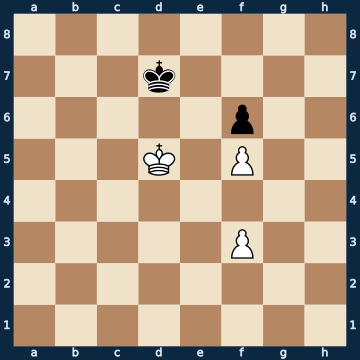
8/3k4/5p2/3K1P2/8/5P2/8/8 w - - 0 1The plan
The doubled pawn counts as a weakness — here it is the whole win. The position is rigid: the white and the black pawn block each other, and the two kings hold each other in a lock. Whoever HAS to move in such a position gives ground. This can be measured exactly: take the rear doubled pawn off the board, and the position with White to move is a draw — none of the four possible moves wins any more. The same position with BLACK to move, on the other hand, is won for White, and it makes no difference what Black plays — all five moves lose. This is mutual zugzwang in its purest form: quite simply, whoever doesn't have to move wins. The 'useless' rear pawn is the answer to that, because it supplies a move that changes nothing about the position and still passes on the move; with it on the board, two of the five possible moves win, without it none. The zugzwang then pushes the black king aside step by step, and White breaks in on the side just vacated.
Rule of thumb: in the blocked pawn endgame it is not who has more pawns that decides, but who keeps the last pawn move in reserve.
Why this level: The doubled pawn as a reserve tempo
The solution, move by move
- 1. f4 The waiting move: the position stays exactly the same — only the RIGHT TO MOVE changes hands. Without the rear pawn this move would not exist, and the position would be a measured draw; three of the five moves still throw away the win here too (sidelines).Sideline 1. Ke4 The king looks for another way instead of playing the reserve tempo. That gives away the move — and with it the point. 1… Kd6 Black simply takes the opposition. As long as he can hold the face-off, White gets in nowhere. 2. Kf4 Ke7 The ONLY holding move — but it is obvious: stay facing the white king. 3. Kg4 Kf8 4. Kh5 Kg7 Again the only move, and again the same idea. A draw: White spent his waiting tempo on the first move and never gets it back.Sideline 1. Kc4 The attempt to go around the outside. It costs two tempi, and White doesn't have them. 1… Kd6 The black king doesn't follow but goes the other way — toward the white pawn. 2. Kb5 Ke5 3. Kc6 Kxf5 And takes it. The extra pawn has become material equality. 4. Kd7 Kg6 5. Ke8 Kh7 A draw: the black king reaches the corner ahead of the f-pawn. Remember — the reserve tempo wants to be played, not saved up.
- 1… Ke7 The zugzwang takes effect: the black king has to give up the balance.
- 2. Kc6 The outflanking — White breaks in on the side just vacated. Only two of the five moves hold the win.
- 2… Ke8
- 3. Kd6 Always the same pattern: the black king gives way, the white one advances. Four of the seven moves still win, but only this one makes progress.
- 3… Kf7
- 4. Kd7
- 4… Kf8
- 5. Ke6
- 5… Kg7
- 6. Ke7
- 6… Kh7
- 7. Kxf6 The pawn falls, White's own two are ready — the rest is the familiar winning technique of the key squares. The pawn that every textbook calls a weakness has paid for the whole point.
Play it yourself
In the free app C&C Chess Club you step through the line move by move, tap the sidelines and play the position out against Stockfish — no account, no ads.
More in Pawn endgames
- Doubled rook pawn — the corner holds two as well Draw
- Connected passed pawns — advancing under cover White wins
- Shouldering — leading with the shoulder White wins
- The stalemate trap — pawn on the sixth White wins
- The queen skewer — curse of the long diagonal White wins
- Rook-pawn race — the corner saves Draw