 C&C Chess Club
Rook-pawn race — the corner saves
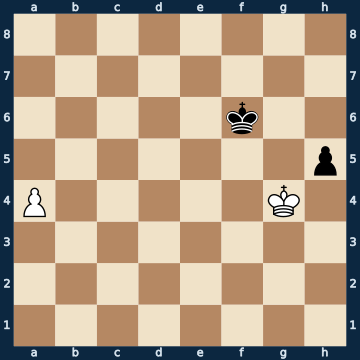
8/8/5k2/7p/P5K1/8/8/8 w - - 0 1The plan
White captures the h-pawn and so has an extra passed pawn — and still only a draw. By plain square-counting that shouldn't even be possible: the black king needs five moves to the queening square, the pawn only four, so the king stands OUTSIDE the square. But with the rook pawn you don't count to the queening square, you count to the CORNER next to it, and there it is just enough. Once the black king stands next to the queening square, the pawn can never get past its own goal and falls. How much this depends on the edge is shown by the counter-test on the position shifted by exactly one file: against the rook pawn the black king holds the draw from 30 of the 58 possible squares, against the neighbouring pawn one file further in from only 16 of 55. The direction has to be right too — immediately after the capture three of the six king moves hold, two moves later only two of eight, and whoever chases after the pawn instead of heading for the corner loses. The diagonal path is exactly as fast as the straight one and keeps both goals in sight.
Rule of thumb: against the rook pawn don't count to the pawn, count to the corner — whoever reaches it draws, even if the square has long since been left.
Why this level: Count to the corner, not to the pawn
The solution, move by move
- 1. Kxh5 White takes the pawn — the race begins: king against passed pawn.
- 1… Ke5 Not after the king, not after the pawn: to the CORNER! The diagonal path e5-d6-c7 is exactly fast enough. Of six moves only three hold here; ...Kg7 in the wrong direction loses (sideline).Sideline 1… Kg7 The wrong direction. The king runs home instead of to the corner — and the measured draw turns into a plain loss. 2. a5 Now White doesn't need to do anything clever: the pawn simply runs, and the black king always arrives one step too late. 2… Kf7 3. a6 Ke7 4. a7 Kd7 5. a8=Q The queen stands. A single king move in the wrong direction has cost the half point.
- 2. a5
- 2… Kd6 The calculation: the pawn still needs three steps to a8, the king only two to b7 — it is enough. Only two of the eight moves still hold the draw now; ...Ke6 after the pawn loses (sideline).Sideline 2… Ke6 The natural move: toward the pawn. It loses, because it puts the king exactly one square off from the corner. 3. a6 The ONLY winning move of six — and again it is the pawn, not the king. Whoever hesitates here lets Black reach b7 after all. 3… Kd7 4. a7 Again the only winning move. The difference from the main line is a single square: there the black king now stands on b7, here on c7. 4… Kc7 5. a8=Q And the queen stands, because c7 simply isn't b7. That is how tight the corner arithmetic is.
- 3. a6
- 3… Kc7
- 4. a7
- 4… Kb7 Arrived. On a7 the pawn can never get past its own queening square —
- 5. Kg4
- 5… Kxa7 — and falls. A draw: the corner was closer than the promotion.
Play it yourself
In the free app C&C Chess Club you step through the line move by move, tap the sidelines and play the position out against Stockfish — no account, no ads.
More in Pawn endgames
- The stalemate trap — pawn on the sixth White wins
- Eat or run — the square backwards White wins
- Connected passed pawns — advancing under cover White wins
- One pawn holds two — the saving trade Draw
- The doubled pawn as a tempo reserve White wins
- Corresponding squares (Lasker-Reichhelm 1901) White wins