 C&C Chess Club
One pawn holds two — the saving trade
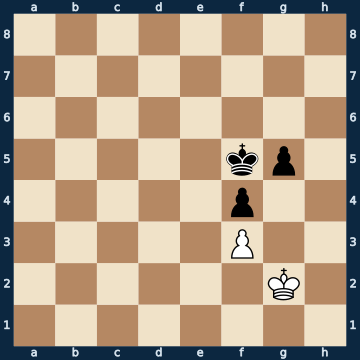
8/8/8/5kp1/5p2/5P2/6K1/8 w - - 0 1The plan
Two connected passed pawns against one — and still a draw. The single white pawn blocks both at once: it holds the front one in place and at the same time guards the square the rear one wants to move to. This double effect is the whole reason the position holds, and it depends on one condition — the two black pawns must stand SIDE BY SIDE. The counter-test shows how tight this is: move the rear of the two back by just one square, so they no longer stand side by side, and White loses in every continuation, all six possible moves. In the position itself, two of six moves hold the draw, the other four lose: the king has to keep contact with his own pawn, and every step into the corner costs half a point. If Black finally does push his rear pawn forward, it gets even sharper — then exactly one move of six holds, namely the immediate capture. It turns everything into the familiar draw of king against pawn from the opposition lesson, while any king move at this point loses.
Rule of thumb: one pawn holds two as long as they stand side by side — and the moment one advances, you trade instead of waiting.
Why this level: Only the saving trade holds
The solution, move by move
- 1. Kf2 Stay by the pawn! Of the six possible moves, only this one and Kf1 hold the draw, the other four lose. The king may never give up contact with f3 (sideline).Sideline 1. Kg1 The king steps aside instead of staying by his own pawn. One of four moves that turn the measured draw into a loss. 1… Ke5 And at once the black king marches off — not to his own pawns, but around the white king. 2. Kf2 Kd4 3. Ke2 Kc3 4. Kf1 Kd3 The outflanking route via the queenside. White has nowhere to go: his king is tied to f3, and Black has all the time in the world. 5. Kf2 Kd2 6. Kf1 Ke3 7. Kg2 Ke2 8. Kh3 Kxf3 The pawn falls, and with it the whole blockade. Without it, both black pawns run through. Remember: the rescue was not the pawn alone, but pawn AND king together.
- 1… g4 Black sets the trap: ...g4 offers the pawn while at the same time threatening to break through with ...g3.
- 2. fxg4+ Capture IMMEDIATELY — the only holding move of six! Any king move would lose to ...g3 (sideline). The capture, on the other hand, leads into an endgame every club player can hold.Sideline 2. Kg2 Hesitating instead of trading. The move looks harmless and is the only mistake this position still allows — here only the capture holds and nothing else. 2… g3 The ONLY winning move for Black, and it is easy to find: the pawn runs past the blocking f3-pawn. From now on White faces two passed pawns instead of none. 3. Kh3 Kf6 4. Kg2 Ke5 5. Kh3 g2 The pawn advances to the seventh rank and forces the king to take it — the decisive distraction. 6. Kxg2 White has to capture, but in doing so loses all contact with the f-pawn. 6… Kd4 The ONLY winning move: the black king hurries to his remaining pawn and escorts it through. This is exactly the endgame the trade avoided in the first place.
- 2… Kxg4
- 3. Kg2 The rest is familiar: king IN FRONT OF the pawn — the drawing defence from the opposition lesson.
- 3… f3+
- 4. Kf2
- 4… Kf4
- 5. Kf1 Retreat STRAIGHT back and stay in front of the pawn — rule two of the drawing defence.
- 5… Ke3
- 6. Ke1 The only holding move: STRAIGHT back, not sideways. Only this way does the king face its counterpart again once the pawn advances.
- 6… f2+
- 7. Kf1 And again the only move: in front of the pawn. On e1 the king would stand beside it instead of in front, and the pawn would queen.
- 7… Kf3 STALEMATE — the same conclusion as in the opposition draw. 'One pawn against two' has turned into half a point.
Play it yourself
In the free app C&C Chess Club you step through the line move by move, tap the sidelines and play the position out against Stockfish — no account, no ads.
More in Pawn endgames
- Eat or run — the square backwards White wins
- Corresponding squares (Lasker-Reichhelm 1901) White wins
- Rook-pawn race — the corner saves Draw
- Wing majority 3 against 2 — the candidate first White wins
- The stalemate trap — pawn on the sixth White wins
- The active king outweighs a pawn Draw