 C&C Chess Club
Wing majority 3 against 2 — the candidate first
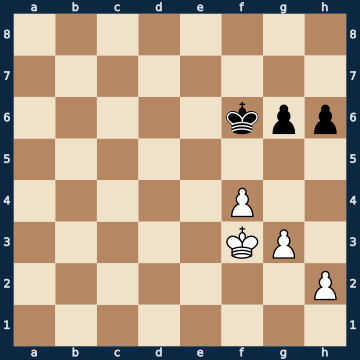
8/8/5kpp/8/5P2/5KP1/7P/8 w - - 0 1The plan
Three against two on the same wing: the extra pawn is meant to become a passed pawn. The order for this is called CANDIDATE FIRST — the pawn allowed to advance is the one with NO black opposite number on its file, here the f-pawn, and the other two support it from behind. That it really is the order that decides, and not the pawn count, is measured: of the ten moves in the starting position, eight win, and the only two that give away the point are exactly the two violations of the rule. The first is the wrong pawn — if the rook pawn advances two squares at once, Black gets a blocking square, and that block is, measured, his ONLY saving move of seven, every other one loses. The second is the right pawn at the wrong time: if the candidate rushes forward before its neighbours support it, it simply gets traded off, and nothing comes of the majority. After the quiet preparatory move, on the other hand, things run almost by themselves — only once more is precision needed, there two of six moves hold the win, after that the front carries itself.
Rule of thumb: support first, then push — and only the pawn with no opposite number is allowed to push.
Why this level: Converting a majority, candidate first
The solution, move by move
- 1. h3 The quiet preparatory move. h3 supports the coming g4 — and avoids the self-inflicted trap 1.h4? h5!, after which no passed pawn ever arises again. Of ten moves, eight win; the two exceptions are exactly 1.h4? and 1.f5? (both as sidelines).Sideline 1. h4 The wrong pawn — and one of only two moves that throw away the win: 1… h5 ...h5! Now all the pawns face each other rigidly — no passed pawn can be created any more, a draw. Measured, it is the ONLY saving move of seven: every other one loses.Sideline 1. f5 The right pawn, but rushed forward too soon — 1… gxf5 — and the candidate gets traded instead of getting through: a draw. Black has two captures to choose from for this, and either one is enough.
- 1… Kf5
- 2. g4+ With tempo: the pawn chain advances as a closed front and pushes the king aside at the same time. Here it is tight — only two of the six moves hold the win.
- 2… Ke6
- 3. h4 NOW h4 is safe — the black king is too far away to still block with ...h5. The front stands.
- 3… Kd5
- 4. f5 THE CANDIDATE. f5 is the pawn WITHOUT a black opposite number — only it can become a passed pawn, and that is exactly why it is the one that breaks through. Premature (1.f5?) would have been met by gxf5; now g4 and h4 support the advance.
- 4… Kc4
- 5. fxg6 The breakthrough is complete: the majority has become a passed pawn.
- 5… Kd4
- 6. g5 Push on, don't stand still — the connected pawns cover each other as they advance.
- 6… Ke5
- 7. gxh6 And the second pawn falls too. 3 against 2 has become two passed pawns, and the king cannot stop both.
- 7… Kf6
- 8. h5
- 8… Ke5
- 9. g7 Unstoppable: the black king stands on the wrong side of the board.
- 9… Kd4
- 10. g8=Q The queen has arrived. The whole win lay in the first, unassuming move 1.h3! — preparation before the push.
Play it yourself
In the free app C&C Chess Club you step through the line move by move, tap the sidelines and play the position out against Stockfish — no account, no ads.
More in Pawn endgames
- Corresponding squares (Lasker-Reichhelm 1901) White wins
- The active king outweighs a pawn Draw
- One pawn holds two — the saving trade Draw
- The distant passed pawn — the decoy White wins
- Eat or run — the square backwards White wins
- The protected passed pawn — the fetter White wins