 C&C Chess Club
Opposition — king in front of the pawn wins
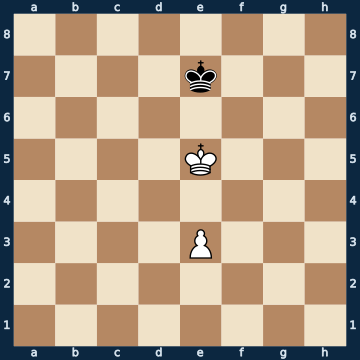
8/4k3/8/4K3/8/4P3/8/8 w - - 0 1The plan
The opposition is not a rule to learn by heart, it is an idea: two kings stand facing each other on a file, neither may step closer, and whoever HAS to move gives the other room. So whoever is to move does NOT have the opposition. On the board you recognise it by an odd number of free squares between the kings — here it is exactly one, so Black has the opposition, and White wins anyway: measured, the win holds even with Black to move. Because the white king is already ahead of its pawn, and this lead in position outweighs a tempo. Three of the six possible moves win, the three retreats to the rank below give up the point at once; it is just as much a draw if the king stays behind or beside its pawn instead of in front of it. How sharp the tempo would otherwise be is shown by the counter-test: move both kings back one rank and leave the pawn where it is, and White only wins if BLACK has to move — otherwise it is a draw. Distant opposition, key squares, and triangulation — all three separate lessons in this collection — are nothing but extensions of this one idea.
Rule of thumb: the king goes first, the pawn follows; whoever forces the opponent to give way has already won.
Why this level: Opposition is the foundation
The solution, move by move
- 1. Kd5 The king goes AHEAD and takes space. The pawn stays back — it is the reserve tempo that later hands the zugzwang back. Of the six moves in the starting position, three win; any retreat to the fourth rank is a measured draw.Sideline 1. Ke4 The most common beginner's mistake: the king places itself BESIDE the pawn instead of in front of it. That gives up the opposition — and without opposition there is no key square. 1… Ke6 The only move, but Black finds it easily: king against king, one square between them, White to move. From here on Black has the opposition. 2. Kd4 Kd6 3. e4 Ke6 Always the same picture: White moves, Black takes back the opposition. The pawn makes progress, the king does not. 4. e5 Ke7 5. Kd5 Kd7 A draw. The pawn stands on d5, the king beside it instead of in front — exactly the position the main line avoids.
- 1… Kd7
- 2. e4 Black held the opposition — so the PAWN moves exactly one step and hands the zugzwang back to Black. That is the whole purpose of the pawn staying behind.
- 2… Ke7
- 3. Ke5 The ONLY winning move among six — and again not a pawn move. The king takes back the opposition; if the pawn runs ahead instead, the game ends in stalemate (sideline).Sideline 3. e5 The second great mistake: the pawn runs AHEAD. This looks fast but takes away exactly the squares his own king needs. 3… Kd7 The only move — and from here on Black needs nothing more than to keep standing in front of the pawn, again and again. 4. e6+ Ke7 5. Ke5 Ke8 6. Kd6 Kd8 7. e7+ The check looks like progress — 7… Ke8 8. Ke6 — and is STALEMATE. Remember: the king goes ahead, the pawn follows. Never the other way round.
- 3… Kd7
- 4. Kf6 The OUTFLANKING: Black had to give up the opposition, the white king slips past on the side. That is exactly what the attacker fought for the opposition for — it is not an end in itself but the ticket to the squares in front of the pawn.
- 4… Kd8
- 5. e5 Now the pawn may advance, because the king is already two ranks ahead of it. The order is always the same: first gain space, then push.
- 5… Ke8
- 6. Ke6 Here too only this one move of six holds the win: first the opposition, then the pawn. This exact order is the whole lesson of the piece.
- 6… Kd8
- 7. Kf7 From f7 the queening square e8 is firmly in White's hands — the pawn marches through undisturbed.
- 7… Kc7
- 8. e6
- 8… Kb6
- 9. e7
- 9… Kc5
- 10. e8=Q The queen stands, without White ever having done anything other than take the opposition and push on.
Play it yourself
In the free app C&C Chess Club you step through the line move by move, tap the sidelines and play the position out against Stockfish — no account, no ads.
More in Pawn endgames
- Opposition — the drawing defence Draw
- Rook pawn — the saving corner Draw
- The Reti manoeuvre — one king, two goals Draw
- Triangulation — losing a tempo White wins
- Blocked pawns — the outflank White wins
- Distant opposition — opposition at a distance White wins