 C&C Chess Club
Queen against pawn on the sixth — this is where the exceptions end
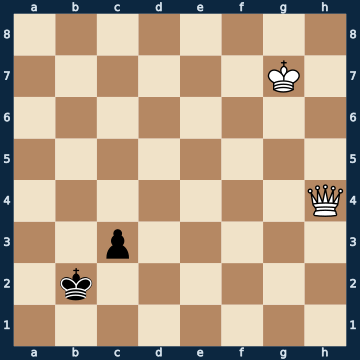
8/6K1/8/8/7Q/2p5/1k6/8 w - - 0 1The plan
All the famous drawing cases — bishop pawn, rook pawn, stalemate in the corner — assume that the pawn has already reached the second-to-last rank. Move it back a single square, and the whole theory collapses: against a pawn on the third-to-last rank the queen always wins, no matter which file it stands on. The reason is a tempo. The queen sets herself up so that the pawn cannot move without being lost, and so wins the time to bring up her own king. If the pawn advances anyway, the queen goes behind it onto the queening square and freezes it there forever. From then on White is effectively playing with an extra piece against an opponent who can do nothing but shuffle his king around. But be careful: the path is still narrow — in the starting picture only three of twenty-nine moves win.
Rule of thumb: on the second-to-last rank the pawn is sometimes saved by stalemate, one rank earlier never — there the queen wins the tempo for her king.
Why this level: One rank earlier there are no more exceptions
The solution, move by move
- 1. Qd4 One of only three winning moves. The queen places herself in front of the pawn and takes away its forward square — any king move, by contrast, lets the pawn reach the second-to-last rank and so the draw (first sideline).Sideline 1. Kf6 The natural move — bring the king up first, the queen already stands well. It costs the whole point. 1… c2 Because the pawn goes to the second-to-last rank, and there it is a bishop pawn: from now on the stalemate trap from the earlier lesson applies. 2. Qd4+ Kb1 The king shuttles around the corner, the queen never gets the chance to bring up her own king. A draw.
- 1… Kb3 The pawn is blocked, so Black defends it with the king.
- 2. Kf6 The tempo won: the white king sets off while the pawn sits stuck.
- 2… c2 The breakthrough attempt — now or never.
- 3. Qa1 The ONLY winning move. The queen goes BEHIND the pawn onto its queening square. She stands there for the rest of the game, and the pawn is dead (the second sideline shows what a waiting move costs).Sideline 3. Ke5 A single move of hesitation instead of the move behind the pawn — and the win is gone. 3… Ka2 The king heads toward the corner. The queen can no longer occupy the queening square now, because she has to keep an eye on the pawn, 4. Kd5 Kb1 and Black holds with the same stalemate trap as always: the king shuttles between the two squares on the edge. That is exactly why the queen has to get behind the pawn AT ONCE.
- 3… Kc4
- 4. Ke6 On with the king. Black can only watch.
- 4… Kd3
- 5. Qc1 The queen switches to the neighbouring square: she keeps covering the queening square and cuts off the king's rank at the same time.
- 5… Kc3
- 6. Kd5 The king comes closer — square by square, with no hurry at all.
- 6… Kb3
- 7. Kd4
- 7… Ka2
- 8. Kd3
- 8… Kb3 The ONLY move Black still has. That puts him right under the blade.
- 9. Qxc2+ The pawn falls with check. What's left is the basic mate with the queen.
Play it yourself
In the free app C&C Chess Club you step through the line move by move, tap the sidelines and play the position out against Stockfish — no account, no ads.
More in Queen endgames
- Queen against rook pawn — the corner saves Draw
- Queen against two connected pawns — the wall on the seventh Draw
- Queen against two rooks — cover each other or lose White wins
- Queen against rook and knight — no way through Draw
- Queen against bishop pawn — where the king must stand White wins
- Queen and pawn against queen — the bishop pawn wins White wins