 C&C Chess Club
The more advanced pawn — why the trade is the weapon
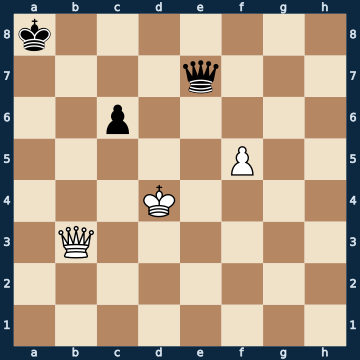
k7/4q3/2p5/5P2/3K4/1Q6/8/8 w - - 0 1The plan
When both sides have a passed pawn, almost everything is decided by the lead. Measured across thirty thousand random positions: if both pawns are equally far advanced, the player to move wins barely half the time and it is just as often a draw. Just one rank's lead turns that into six wins out of ten, two ranks nearly seven, three ranks three quarters. Only the lead is worthless as long as the queens are still on the board — the weaker side holds with perpetual check, and the further the pawn runs, the more exposed its own king stands. That is why the stronger side has a quite different goal with this material: not promotion, but the queen trade. The way there is a king march INTO the enemy checks rather than away from them — the closer your own king gets to the enemy queen, the fewer checking squares remain for her. Once he stands in the corner, your own queen can force the trade, and what remains is a pawn race that the more advanced pawn wins comfortably.
Rule of thumb: in the queen endgame it is not the faster pawn that wins, but the side whose owner can force the queen trade.
Why this level: The queen trade at the right moment — before that nothing wins
The solution, move by move
- 1. Qe6 The ONLY winning move of twenty-seven. The queen places herself in the middle of the coming king route — she is meant to accompany the march, not push the pawn. Advancing the pawn itself falls completely flat (first sideline).Sideline 1. f6 The reflex: the pawn is the trump card, so let it run. 1… Qxf6+ Only the black queen already stands on its diagonal. The pawn falls with check, and a won position has become a dead draw. In the queen endgame the pawn runs last, not first.
- 1… Qb4+ Black starts the check series. He has nothing else: his own pawn is two ranks behind.
- 2. Ke5 The king walks TOWARD the check. That is the whole trick of this endgame and is hard for everyone — dodging backward gives away the win on the spot (second sideline).Sideline 2. Kd3 Dodging back from the check — the most natural move in the world, and it costs the full point. Only two of the four king moves win, and both go FORWARD. 2… Qg4 Black sets up the queen so that she keeps an eye on both the pawn and the queening file at once. 3. Qe8+ Kb7 And now the black king comes up too. White has no square left from which to force the trade. 4. Qh8 Kc7 5. Qf8 Kd7 The pawn never gets through, because the black queen keeps it under permanent watch and the white king stands too far away. A draw.
- 2… Qb8+
- 3. Kf6 And further forward. With every step the number of squares from which the black queen can even give check keeps shrinking.
- 3… Qb6
- 4. Kg7 The king heads for the corner — where the fewest diagonals and files reach him. A king in the corner is often safer in the queen endgame than one in the centre.
- 4… Qc7+
- 5. Kf8 One more step, and now the king stands so that his own queen can interpose at the next check without hanging herself.
- 5… Qd8+
- 6. Qe8 There's the trade. Black cannot dodge: if he doesn't take, his queen falls for nothing; if he does take, the race begins — and he has already lost it.
- 6… Qxe8+
- 7. Kxe8 The ONLY move, and the only legal one too. From here on it is pure arithmetic.
- 7… Kb7
- 8. f6 Three moves to promotion for White, five for Black. Two tempi of lead, and both kings stand too far away to change anything about it.
- 8… c5
- 9. f7
- 9… c4
- 10. f8=Q White gets there two moves sooner. The lead that was worth nothing with queens on the board decides everything without them.
Play it yourself
In the free app C&C Chess Club you step through the line move by move, tap the sidelines and play the position out against Stockfish — no account, no ads.
More in Queen endgames
- Perpetual check or mate — the king marches behind the queen White wins
- Perpetual check or promotion — it must start at once Draw
- Queen against rook and bishop — both on a knife's edge Draw
- Trade first, then promote — the pawn captures forward White wins
- Queen against two knights — the king step decides White wins
- The king looks for cover — behind the enemy pawn White wins