 C&C Chess Club
Queen against rook and bishop — both on a knife's edge
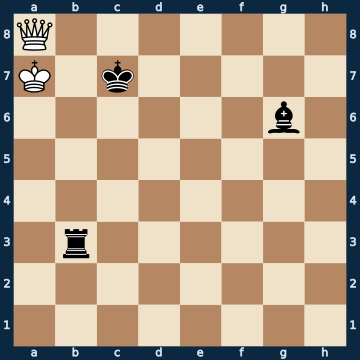
Q7/K1k5/6b1/8/8/1r6/8/8 w - - 0 1The plan
Rook and bishop are the toughest material distribution against the queen among all two-piece cases: measured over random positions, roughly every fourth ends in a draw — clearly more than with rook and knight, where it is every fifth. If both pieces stand close to their own king, it is even three out of five. So whoever wins the queen and gives up rook and bishop for it has often won nothing. But this position shows a second thing that is easily forgotten: the queen's side itself stands on the edge of the abyss here. Its king sticks to the edge of the board, and rook and bishop already form half a mating net; of fifteen moves exactly one holds the draw, all the others lose. And the opponent does not have it easier either — it too repeatedly faces positions in which only a single move keeps the winning attempt alive. The balance is therefore real, but it is a balance on a knife's edge. The rule for the side with the queen is: the queen belongs far away from its own king, on a square from which it can check continually, and never on a square the rook can reach.
Rule of thumb: rook and bishop do not just hold the queen up, they threaten it — the side with the queen is defending here, not attacking.
Why this level: Both sides on a knife's edge
The solution, move by move
- 1. Qf8 The ONLY move that holds the draw — fourteen others lose. The queen goes as far away as possible and at the same time places itself on a diagonal from which it can keep disturbing the king. Centralising would be mate (first sideline), trading is also lost (second sideline).Sideline 1. Qd5 The most natural move in the world: the queen into the centre, where it sees everything. 1… Ra3+ The ONLY move — and it is immediately decisive. The rook gives check on the file the king is stuck to. 2. Qa5+ White has only one legal move left: block with the queen. 2… Rxa5# Mate. It can go this fast when your own king stands on the edge and the queen is too far away.Sideline 1. Qb7+ The escape that offers itself: check, trading the queen for the rook in the process. 1… Rxb7+ The ONLY move — and Black of course recaptures with the rook, not the king. 2. Ka6 Rb8 Rook and bishop against the bare king is a basic mate. Whoever gives up their queen for rook and bishop has not made a trade, but lost the game.
- 1… Rb7+ The ONLY move that keeps Black's winning chance alive: the rook cuts the king off on the seventh rank.
- 2. Ka8 The king goes into the corner — correct here for once, because in the open it would be mated at once.
- 2… Rb5 Again the ONLY move. The rook goes back to a square from which it locks the king in without being attackable itself.
- 3. Qg7+ White disturbs. It cannot do more than that, but it is enough.
- 3… Kc8 And once again the ONLY move for Black. You can see it: both sides are balancing.
- 4. Ka7
- 4… Be8 The bishop is regrouped. Rook and bishop want to build a mating net the queen can no longer check its way out of.
- 5. Qh8
- 5… Kd8 The black king goes to the centre of the board, because there it does not stand in its own pieces' way as they set up.
- 6. Qg8
- 6… Ke7
- 7. Qh8
- 7… Bf7 And here it ends: the queen keeps coming back to the diagonal, the mating net never closes. A draw — but a draw that has demanded a dozen precise moves from each side.
Play it yourself
In the free app C&C Chess Club you step through the line move by move, tap the sidelines and play the position out against Stockfish — no account, no ads.
More in Queen endgames
- Queen against two knights — the king step decides White wins
- Perpetual check or mate — the king marches behind the queen White wins
- Queen against two bishops — won, but not within fifty moves White wins
- The more advanced pawn — why the trade is the weapon White wins
- Perpetual check — the only rescue for the weaker side Draw
- Perpetual check or promotion — it must start at once Draw