 C&C Chess Club
Perpetual check or mate — the king marches behind the queen
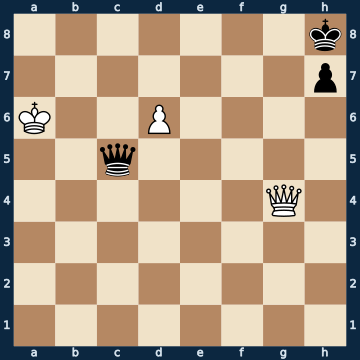
7k/7p/K2P4/2q5/6Q1/8/8/8 w - - 0 1The plan
As soon as both sides have a pawn, every queen endgame poses the same question: is perpetual check enough, or does the attacking king find a way out? Measured against two and a half thousand randomly generated won and drawn positions of this material each, this is a frighteningly sharp question — in a won position, more than one in three has EXACTLY ONE winning move, while in a draw almost always half a dozen moves hold. So whoever stands better has to calculate; whoever stands worse often gets to breathe. Here the position shows both at once. The white king stands on the edge and is hunted from the very first second; the rescue is not to cover the checks, but to place your own queen so that it can step in between at any point along the way. For this the queen goes in front of its own pawn and covers the king's whole path along the seventh rank. After that the king runs right across the board, and every time it gets tight, the queen blocks with a counter-offer. In the end it is not promotion that decides but a mate — and the black king is mated by its own pawn, never moved, which takes away its last escape square.
Rule of thumb: in the queen endgame the queen covers the king, not the pawn — and a pawn in front of your own king is either a roof or a coffin lid, never both.
Why this level: The king march across the whole board while the queens check
The solution, move by move
- 1. Qd7 The ONLY winning move out of twenty-five. The queen places itself in front of its own pawn and thereby covers the whole seventh rank — exactly the path the king is about to take. Whoever dodges with the king instead loses the pawn (first sideline); whoever puts the queen in the centre, where it has more squares, finds not a single covering square left (second sideline).Sideline 1. Kb7 The natural move: get out of the corner before the checks come. Only now the pawn is undefended. 1… Qxd6 And it is gone. Without the pawn White has nothing left to expose the king for. 2. Ka7 Qf8 3. Kb6 Qg8 Black offers the trade, and White has to take it — otherwise he gets mated himself. 4. Qxg8+ Kxg8 Bare king against king and rook pawn. White reaches the corner just in time: a draw. The whole win was broken by a single king move.Sideline 1. Qe6 The queen into the centre, where it commands the most squares — and covers its own pawn. Sounds sensible and is still only a draw. 1… Qc6+ The difference: from here the queen covers the pawn but not a single square on the king's path. Black simply keeps checking. 2. Ka7 Kg7 And Black even gains time for its own king, which steps out of the corner. The mating picture from the end of the main line can now never happen. 3. Kb8 Qb6+ 4. Kc8 Qc6+ Perpetual check. The white king finds nowhere a square where its queen could shield it — that is exactly what it would have needed to stand in front of the pawn for.
- 1… Qc4+ Black has only one means, and reaches for it at once: check after check, until the white king runs out of squares.
- 2. Kb7 The king goes to the seventh rank — exactly where its own queen covers it. From here on the rule is: never back, always further forward.
- 2… Qb4+
- 3. Kc8 Two squares gained. You can see where this is heading — the king seeks out the area where the black queen has the fewest checking squares, and that happens to be the opponent's own side.
- 3… Qc4+
- 4. Qc7 Now the queen does what it was placed there for: it steps in between and thereby offers the trade itself. Black must not take, so it has to keep checking — and loses strength move by move as it does.
- 4… Qa6+
- 5. Kd8 The king goes one square further again. The pawn stays behind for now; it has done its duty by giving the queen its stand-by square.
- 5… Qa8+
- 6. Qc8 The same means again: step in between and offer the trade. This is how the check series shrinks on its own.
- 6… Qa5+
- 7. Ke8 The king reaches the back rank and in doing so places itself directly in its own queen's line of fire. This looks like self-blocking and is in truth the whole point.
- 7… Qh5+
- 8. Ke7+ The king steps aside and clears the file: this is a discovered check, because its own queen now looks all the way along the eighth rank into the corner. The hunted has become the hunter.
- 8… Kg7
- 9. Qf8+
- 9… Kg6 The ONLY move — and already the last one. The king could only go to the other square if its own pawn were not standing there.
- 10. Qf6# Mate. The black king has no way out, because its own queen and its own pawn block its last two squares. This is exactly what this lesson warns against.
Play it yourself
In the free app C&C Chess Club you step through the line move by move, tap the sidelines and play the position out against Stockfish — no account, no ads.
More in Queen endgames
- Queen against rook and bishop — both on a knife's edge Draw
- The more advanced pawn — why the trade is the weapon White wins
- Queen against two knights — the king step decides White wins
- Perpetual check or promotion — it must start at once Draw
- Queen against two bishops — won, but not within fifty moves White wins
- Trade first, then promote — the pawn captures forward White wins