 C&C Chess Club
Opposite-coloured bishops — the pawn may even promote
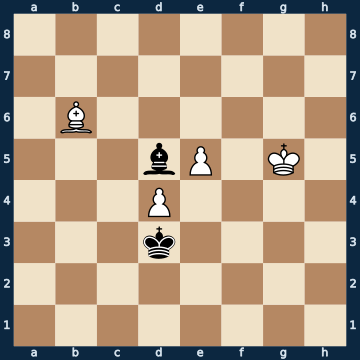
8/8/1B6/3bP1K1/3P4/3k4/8/8 b - - 0 1The plan
Here too, two extra pawns stand against a single bishop, and here too they do not win — but for a completely different reason than usual. Nothing can be blockaded here: both pawns stand on dark squares, and the defending bishop is light-squared. But the dangerous pawn's queening square has the same light colour as this bishop, and that is entirely sufficient. So the defender does not get in the way at all, but goes onto the light diagonal leading to the queening square, and lets the pawn march on calmly. If it promotes, the brand-new queen is captured in the very same instant — and the second pawn alone never has a chance against opposite-coloured bishops. The king, meanwhile, has only one task: it stays near the rear pawn and must not let itself be lured into the other corner; at the start, exactly one move out of twenty holds, and it is a king step. Measured for comparison: the same bishop on dark squares loses the position at once, because it can never reach the light queening square.
Rule of thumb: check the colour of the queening square — if it matches the colour of your bishop, you can safely let the pawn become a queen.
Why this level: The idea is catchy and sticks immediately, but it demands the courage to let the opponent promote — only someone who has consciously checked the colour of the queening square dares that.
The solution, move by move
- 1… Kc4 The ONLY move out of twenty. The king approaches the rear pawn from the side instead of standing in front of the front one — it could never reach the front one anyway, and the rear one is the one it can actually hold up. Every other king step and every bishop move loses (first sideline).Sideline 1… Ke4 The king goes to the front pawn instead of the rear one — the most natural move in the position, and a losing one. 2. Kf6 Now the white king defends the pawn, and the black bishop has to guard the diagonal all alone. 2… Bg8 3. e6 Bh7 4. Kg7 The king goes after the bishop. On the short diagonal it has no square left where it is not attacked. 4… Bg8 5. Kxg8 The bishop falls, and the pawns run. This is exactly why the king has to go to the REAR pawn: the bishop guards the front one.
- 2. Kf6
- 2… Kb5 Again the ONLY move, and again the same idea: the king stays within the square of the rear pawn and keeps out of the white king's way.
- 3. e6
- 3… Bf3 The bishop switches to the long light diagonal. From there it sees the queening square — that is all it needs, because it does not want to hold up the pawn at all.
- 4. Bd8
- 4… Kc6 For the third time the ONLY move. The king goes TOWARDS the pawn instead of waiting; it will soon be needed in front of the queening square.
- 5. e7 White poses the question: the pawn stands ready to promote and cannot be stopped.
- 5… Kd7
- 6. Kf7
- 6… Bh5+ And this is the answer — again the ONLY move. The bishop goes with check onto the diagonal that ends on the queening square. On any other square it arrives too late (second sideline).Sideline 6… Bh1 The bishop stays on the long diagonal — but it does not lead to the queening square, it passes it by. 7. Kf8 Kc8 8. Bc7 The white bishop places itself in the black king's path. This costs the bishop, but the pawn gets through. 8… Kd7 9. e8=Q+ And there stands the queen. This time nobody can capture it — the bishop does not see the square. 9… Kxc7 10. Qf7+ With queen against bishop everything is decided. One square on the wrong diagonal made the difference.
- 7. Kf8
- 7… Bg6 The bishop takes the last free point on this diagonal. Now White can promote as often as it likes.
- 8. e8=Q+ The promotion with check looks dangerous and is not.
- 8… Bxe8 The ONLY move — and the whole punchline of the lesson: the bishop takes the brand-new queen. What remains is bishop and one pawn against a bishop of the opposite colour, and that has always been a draw.
- 9. Be7
Play it yourself
In the free app C&C Chess Club you step through the line move by move, tap the sidelines and play the position out against Stockfish — no account, no ads.
More in Fortresses
- Opposite-coloured bishops — one square holds both pawns Draw
- Rook against doubled pawns — two pawns that are only one Draw
- Rook against f- and h-pawns — the gap saves Draw
- Bishop and pawn against knight — the fortress in front of the pawn Draw
- Rook and pawn against the queen — the castled fortress Draw