 C&C Chess Club
When to trade
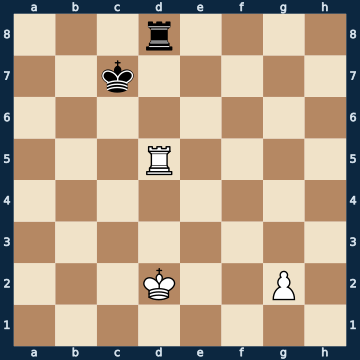
3r4/2k5/8/3R4/8/8/3K2P1/8 w - - 0 1The plan
Simplifying is a plan, not a renunciation. White is a pawn up, but as long as the rooks are on the board it gets no further: the black rook holds the file, checks from the side and places itself behind the pawn. Measured, exactly ONE of fifteen moves wins here, and it is the trade. After that it is a pawn endgame, and pawn endgames are calculated, not felt: the white king takes the shortest path to the pawn, goes around the black king via the edge file, and reaches the sixth rank IN FRONT OF its own pawn. From there the pawn wins on its own. Two things you have to know here: the king must not go via the wrong side — a single square over and the race is a draw; and with a rook pawn instead of a knight pawn, the same position would be a draw from the start, because the black king could occupy the corner.
Rule of thumb: trade when you can CALCULATE the resulting endgame — and calculate it beforehand, not afterwards. The counterpart is called 'The saving trade'.
Why this level: When to trade
The solution, move by move
- 1. Rxd8 The ONLY winning move out of fifteen. Everything else lets the black rook live, and with it the pawn cannot be brought home — three moves even lose White's own rook (sidelines).Sideline 1. Rd3 The rook avoids the trade and stays active. Looks sensible but throws away the win. 1… Rg8 The black rook places itself BEHIND the pawn. From there it cannot be driven off, and the pawn does not advance a single step further: a draw. 2. Rd5 Re8Sideline 1. Rd6 The trap of facing each other on the same file: whoever moves between the rooks instead of trading simply loses a piece. 1… Rxd6+ Rook gone. The win has turned into a lost game.
- 1… Kxd8
- 2. Ke3 Now the race. Of the ten king moves, only three win, and all three go RIGHT; the move to the other side is already a draw (sideline).Sideline 2. Kc3 The trade was correct — now the wrong path. One square to the left instead of to the right, and the race is lost. 2… Ke7 3. Kd4 Kf6 The black king arrives in front of the pawn in time. Exactly one tempo is missing: a draw. That is why you count in a pawn endgame, not estimate.
- 2… Ke8
- 3. Kf4
- 3… Kf7
- 4. Kg5 The king overtakes the black one. That is the heart of every pawn endgame: it is not the pawn that runs first, but the king.
- 4… Kg8
- 5. Kh6 Via the edge file, past the cover. On the sixth rank IN FRONT OF its own pawn the king always wins — no matter who is to move.
- 5… Kh8
- 6. g4 Only now the pawn, and from here on everything runs by itself.
- 6… Kg8 Forced; the black king has only this one square left.
- 7. g5
- 7… Kh8
- 8. g6
- 8… Kg8 Forced again. The king shuttles and watches.
- 9. g7 The ONLY winning move: the pawn, not the king. A king move would free the square and spoil everything.
- 9… Kf7 Forced — the pawn stands on g7, the king covers h7 and h8.
- 10. Kh7 The last move: the king covers the queening square, the pawn becomes a queen.
Play it yourself
In the free app C&C Chess Club you step through the line move by move, tap the sidelines and play the position out against Stockfish — no account, no ads.
More in Endgame principles
- Promotion with a fork Draw
- The saving trade Draw
- Saavedra — the queen is too strong White wins
- The king has to come along White wins
- The pawn too many White wins
- The bishop only sees half the world White wins