 C&C Chess Club
The bishop only sees half the world
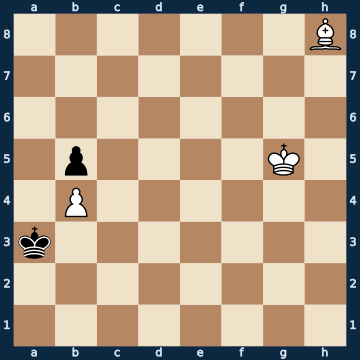
7B/8/8/1p4K1/1P6/k7/8/8 w - - 0 1The plan
A bishop visits only thirty-two squares its whole life. That sounds obvious and still gets forgotten constantly — here it costs the game or wins it. The pawns stand locked against each other, the black king attacks the white pawn, the white king is far away. Only the bishop can still defend the pawn, and it can only defend it if the pawn stands on ITS colour. Exactly one move achieves this, and it takes the bishop right across the long diagonal to the one square from which it holds the pawn; fourteen other moves throw the win away. From there everything runs by itself: the bishop holds and can wait at the same time, the king comes over at leisure, and the black king cannot defend its own pawn and attack the white one at the same time. The counter-check has been measured and is unusually clear: place the same bishop on a square of the other colour, and NONE of the thirty-one possible squares wins — all are draws, while all twenty-seven squares of the right colour win.
Rule of thumb: before you rely on your bishop, check which colour the square in question is — the other half of the board does not exist for it.
Why this level: The bishop only sees half the world — measured: all 27 dark squares win, all 31 light squares are a draw
The solution, move by move
- 1. Bc3 The ONLY winning move out of fifteen. The bishop has to defend its own pawn, and from the corner it reaches exactly one square for that. If it moves anywhere else, the pawn simply falls (sideline).Sideline 1. Bd4 The natural move: the bishop stays on the long diagonal and looks very active. 1… Kxb4 Except it does not defend the pawn — so it is captured. The ONLY move that holds for Black, and it is obvious. 2. Kf5 Kc4 Bishop against pawn: a draw. A win has turned into a half point, because the bishop stood on the wrong diagonal.Sideline 1. Bb2+ And the disaster, for completeness' sake: the bishop goes with check to a square next to the king. 1… Kxb2 Captured. White now stands not only without a piece. 2. Kf5 Kc3 The black pawn runs, the white one cannot be held: White LOSES. One move, three outcomes — win, draw, loss — and the difference is the colour of a square.
- 1… Kb3 The king attacks the bishop and wants to drive it away from its defensive post.
- 2. Bd2 The bishop dodges and stays on the same diagonal — it keeps defending. Only two of seventeen moves do this; whoever leaves the diagonal loses the pawn (sideline).Sideline 2. Bf6 The same mistake one move later: the bishop dodges the king but in doing so leaves the diagonal on which it defends the pawn. 2… Kxb4 Again the pawn falls. The bishop must not only dodge, it must keep its defence while dodging. 3. Kf5 Kc4 A draw. Eleven of the seventeen moves in this position make exactly this mistake.
- 2… Kc4
- 3. Kf6 Now the king may come. The bishop alone holds what needs holding, and White has all the time in the world.
- 3… Kd5
- 4. Ke7
- 4… Kc6
- 5. Ke6 From here on the black king has to guard its own pawn. It cannot do both.
- 5… Kc7
- 6. Kd5
- 6… Kb6
- 7. Kd6
- 7… Kb7
- 8. Kc5
- 8… Ka6
- 9. Kc6 The white king has arrived and attacks the pawn. Black has no square left from which to defend it.
- 9… Ka7 The only legal move — and with that it is over.
- 10. Kxb5 The pawn falls. Bishop and pawn against the bare king win, because the b-pawn is not a rook pawn. The whole win hangs on a single square of the right colour.
Play it yourself
In the free app C&C Chess Club you step through the line move by move, tap the sidelines and play the position out against Stockfish — no account, no ads.
More in Endgame principles
- The king has to come along White wins
- Activity beats material Draw
- The saving trade Draw
- Two pawns on one file White wins
- When to trade White wins
- Kling and Horwitz — won, but not winnable White wins