 C&C Chess Club
Kling and Horwitz — won, but not winnable
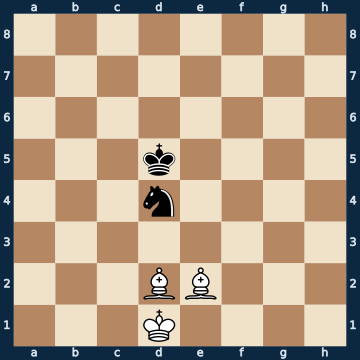
8/8/8/3k4/3n4/8/3BB3/3K4 w - - 0 1The plan
Kling and Horwitz declared this kind of position a draw in 1851. The tablebase disagrees and says: White wins — but only after a hundred and seventeen half-moves, and the 50-move rule allows a hundred. Both are right, then, and that is exactly what this lesson is about: a tablebase win is not the same as a tournament win. The path is the familiar one — drive the knight away from its king, push the king to the edge and into the corner — only there is not enough time for it. The irony is already in the first move: of nineteen possible white moves, only five even hold the theoretical win at all, the other fourteen turn it into a genuine draw on the spot, and twelve of those for the same reason, namely because the knight is allowed to pick up an undefended bishop. So here White can throw away a win it could not have enforced anyway. Measured over forty thousand random positions of this material: a good three quarters are genuine wins, every fifth lies beyond the rule, and the range runs from a single half-move to a hundred and twenty-nine. If the weaker king already stands on the edge, only seven positions in a hundred lie beyond the rule; if it still stands in the centre, it is more than half — the work of getting it to the edge in the first place eats up the fifty moves. A sister lesson in this database shows the same thing with two knights against a pawn.
Rule of thumb: before such an endgame, do not just ask whether it is won, but whether you can win it in fifty moves.
Why this level: Kling & Horwitz 1851: a tablebase win is not always a tournament win
The solution, move by move
- 1. Bd3 The attacked bishop has to move — the knight stands so that it can capture it, and after the trade what remains is a single bishop, which does not mate. Of the nineteen legal moves, only five hold the win, and all five are moves of this very bishop to a safe square. Eleven other moves simply allow the capture, three further bishop moves place the piece on a square where the knight or king picks it up. This one is the fastest of the five.Sideline 1. Be3 Standing in for eleven moves that simply leave the undefended bishop in place. The move looks sensible: the second bishop goes to the centre and takes squares from the knight. 1… Nxe2 And the knight grabs the other bishop. The defender does not need any skill for this — it only has to look. 2. Kxe2 A bishop against the bare king never mates. A draw, in three half-moves, from a position the tablebase calls won.Sideline 1. Bc4+ A check does not protect it either. The bishop does get out of the knight's reach, but places itself right under the king's nose. 1… Kxc4 Captured, and again it is an immediate draw. Of the eight squares the attacked bishop can reach, only five are safe — this one and two others lose the piece.Sideline 1. Kc1 The third way to throw it away: a waiting move with the king. It leaves one bishop hanging and at the same time places the king on a fork square. 1… Nb3+ Knight fork: check and an attack on the second bishop at the same time. Instead of a trade, here the other piece falls. 2. Kc2 Nxd2 The king had to get out of check, so the bishop gets picked up. 3. Kxd2 Again a bishop against the bare king. Three different kinds of mistake, one and the same result.
- 1… Kc5 Black keeps king and knight together. Exactly this closeness is the reason for the long calculation: measured, with a knight directly next to its king, the win lies beyond the rule in forty cases out of a hundred; with a knight at the other end of the board, only in one and a half.
- 2. Bh7
- 2… Kc4
- 3. Bh6 The second bishop comes onto the long diagonal and takes squares away from the knight. Both bishops now work side by side — that is the whole method, and it is slow.
- 3… Ne6 The knight has to dodge but stays within reach of its king. As long as it manages that, every step of progress costs White several moves.
- 4. Bg8
- 4… Kd5
- 5. Bg7
- 5… Kd6
- 6. Bb2 The bishop switches to the other long diagonal, to catch the knight from the other side. The regrouping alone has already cost half a dozen moves, without the black king standing even one step closer to the edge.
- 6… Nd8
- 7. Ke2 Only now may the king march along too, and it has the longest way of all. Without it there is no mate, with it it takes too long.
- 7… Ne6
- 8. Kf3
- 8… Ng5+
- 9. Kg4 From here on the tablebase reports a perfectly ordinary win again instead of a cursed one — but only because it restarts its count at every position. On the board, the clock has been running since the first move: seventeen half-moves already spent plus the hundred reported here again add up to a hundred and seventeen. The rule looks at the game, the tablebase looks at the position — that is the most common misunderstanding on this topic.
- 9… Ne6
- 10. Kf5
- 10… Nd8
- 11. Ke4
- 11… Nb7 The knight finally has to leave its king. That is the first real progress of the whole line, and more than twenty half-moves have already been used up by this point.
- 12. Ba3+
- 12… Kd7
- 13. Bd5
- 13… Kc8
- 14. Be7
- 14… Kb8 After fourteen moves the black king stands on the edge for the first time, and the tablebase says: eighty-nine half-moves left until the knight is captured. Whoever starts counting here has used up half of their budget and done less than a third of the work.
Play it yourself
In the free app C&C Chess Club you step through the line move by move, tap the sidelines and play the position out against Stockfish — no account, no ads.
More in Endgame principles
- Two pawns on one file White wins
- The lone knight — same material, a genuine win White wins
- Activity beats material Draw
- The bishop only sees half the world White wins
- The king has to come along White wins
- The saving trade Draw