 C&C Chess Club
The lone knight — same material, a genuine win
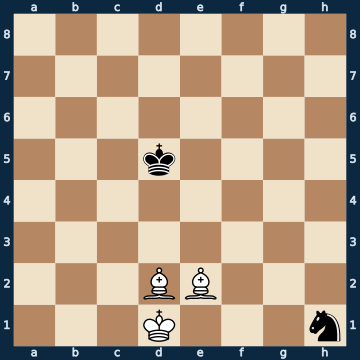
8/8/8/3k4/8/8/3BB3/3K3n w - - 0 1The plan
The same material as in the previous lesson, with a single difference: the knight stands alone in the corner, far from its king. That makes it no longer a case for the 50-move rule but a clean win — the knight falls on the second move. Exactly one move achieves this: the bishop places itself on the long diagonal with check, attacking the knight from there while at the same time blocking the one square the black king could use to come to its aid. Measured: of the seven king moves Black has afterwards, not a single one brings it any closer to its knight than it already stands. Of twenty legal white moves, this one is the only genuine win — sixteen win only on paper, that is, beyond the rule, and three give everything away. After picking up the knight, two bishops stand against the bare king: from there it is, measured, thirty-one half-moves to mate, and in a sample of this material none was found over thirty-four. The comparison is the whole lesson: two bishops deal with a lone knight effortlessly, but against a knight together with its king there is not enough time.
Rule of thumb: whether an endgame can be won in fifty moves is decided not by the material, but by whether the weaker piece stands next to its king.
Why this level: The separated piece falls — and only one move out of twenty truly wins
The solution, move by move
- 1. Bf3+ The ONLY genuine winning move out of twenty. It does three things at once: check, attack on the knight, and it covers the escape square the black king wanted to use to run towards the corner. Every other move lets the knight back to its king — and then either the long calculation from the sister lesson is back on the board, or it is an immediate draw.Sideline 1. Bd3 The bishop goes onto the diagonal, but to the wrong square: it neither attacks the knight nor gives check. 1… Nf2+ This gives the knight a fork and it is saved in one move and active. 2. Ke2 Nxd3 The only move that secures the draw — and it is easy to find: the knight grabs the bishop and in doing so leaves the corner it was trapped in. 3. Kxd3 One bishop remains, so a draw. Two squares' difference on the same diagonal separate a full point from a half here.Sideline 1. Bc4+ A check, but the bishop places itself under the king's nose instead of attacking the knight. 1… Kxc4 Captured — a draw. Of twenty moves, only one truly wins here.
- 1… Ke5 The most stubborn try, and it does not help. From d5 the king was four steps from its knight, from e5 it is still four — no legal king move shortens this distance.
- 2. Bxh1 Knight gone, and with it the point is secure. Two bishops against the bare king now need, measured, thirty-one half-moves to mate from here, well within the rule. This very capture is also why the count starts again at zero: the 50-move clock is reset by every capture.
Play it yourself
In the free app C&C Chess Club you step through the line move by move, tap the sidelines and play the position out against Stockfish — no account, no ads.
More in Endgame principles
- Kling and Horwitz — won, but not winnable White wins
- Two pawns on one file White wins
- Activity beats material Draw
- The bishop only sees half the world White wins
- The king has to come along White wins
- The saving trade Draw