 C&C Chess Club
Frontal defence — the rook in front of the pawn
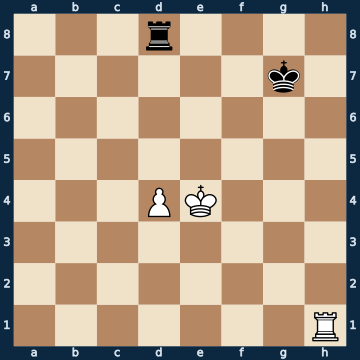
3r4/6k1/8/8/3PK3/8/8/7R b - - 0 1The plan
The second great drawing method besides Philidor: the rook places itself IN FRONT OF the pawn on the pawn's own file. From there the pawn cannot take a single step without being captured — so the work has to be done by the enemy KING. And against him the frontal rook has its weapon: it gives check from the front the moment the king places itself next to the pawn. These checks are not wasted moves but a gain of tempo — with the move it wins, your own king runs in front of the pawn, and there the position is dead. The rook alone is not enough for this, though, and the tablebase says exactly why: your own king may stand at most three files away from the pawn, and it must set off IMMEDIATELY. If it waits even a single move, the opponent blocks the dividing line in between with the rook — then the king can never get across, and the defence collapses even though the rook still stands in front of the pawn.
Rule of thumb: rook frontal in front of the pawn, check for tempo, king off at once — and across the dividing line before it closes.
Why this level: Check for tempo, king off at once
The solution, move by move
- 1… Re8+ First the CHECK, then the king. The rook is already correctly placed frontally; the check drives the white king away from the pawn and hands Black exactly the one tempo his king needs for the way forward. A rook move WITHOUT check (1...Ra8?) and the king move in the wrong direction (1...Kg6?) both lose on the spot — see the sidelines.Sideline 1… Ra8 The mistake: the rook leaves the pawn's file WITHOUT check. The move makes no pressure at all, and it is exactly that one tempo Black is about to miss. 2. Rf1 The ONLY winning move — and the whole point. The rook occupies the f-file and seals it: the black king may not even step onto it and stays walled in on g and h for the rest of the game. Any other white move would only draw. 2… Re8+ 3. Kd5 Rd8+ 4. Kc5 Rc8+ 5. Kb6 Rd8 The checks are used up — the white king has got away from them, and the rook has to go back in front of the pawn. 6. Rf4 The shield on the fourth rank. The white king gets a roof against the side checks, while the black king is still behind the barrier and cannot help. 6… Rb8+ 7. Kc5 Rc8+ 8. Kd6 Rc4 9. Ke5 The king shields the pawn and clears its way. Black has no effective checks left, his king never got into the game — White wins.Sideline 1… Kg6 The king does set off, but on the wrong square: g6 is still ON THIS SIDE of the f-file, and Black has gained no tempo. 2. Rf1 The same refutation as after 1...Ra8?. The rook seals the f-file — and this time you can see it with the naked eye: Kf7 and Kf6 are simply illegal, the king can never get across again. 2… Re8+ The check comes one move too late. It does drive the king back, but the black king cannot make use of the time gained. 3. Kd3 Rd8 4. Kc4 Rc8+ 5. Kb5 Rd8 6. Rd1 Roles reversed: now it is the WHITE rook that holds the d-file, the king is free and either wins the black rook or escorts the pawn. Black has no checks and no king in play — that is lost.
- 2. Kd3
- 2… Kf6 Now the king, and straight across the f-file. Every rook move loses here: White answers 2.Rf1! and shuts the black king out of that path for good.
- 3. d5
- 3… Rd8 The rook returns in front of the pawn. As long as it stands on the pawn's file, the pawn cannot advance a single step without being captured — White has to work with the king and loses time doing so.
- 4. Kd4
- 4… Ke7 The ONLY move — measured: of sixteen possible moves exactly this one holds the draw, all the others lose. The king must go straight in front of the pawn; after Kf7? or Kg6? it would be too slow, and the white king would shove the pawn through (sideline). The frontal rook wins time, but it does not replace your own king.Sideline 4… Kf7 One square off — and the draw is gone. The king stands in front of the pawn here too, but one rank too far back; that one tempo is exactly what is missing at the end. 5. Ke5 The white king marches off. Only three of twenty-two moves win — this is the fastest. 5… Rg8 6. Kd6 And onward. Here even only two moves win: the king has to accompany the pawn, not push it. 6… Ra8 7. Kc7 The king arrives in front of its pawn. From now on the black rook has only checks left, and those run out. 7… Ra7+ 8. Kb6 Sheltered from the checks — exactly the trick from building the bridge. 8… Ra8 9. Re1 The white rook takes over the e-file, the pawn goes through. From e7 the black king would have covered this long ago.
- 5. Kc5
- 5… Rc8+ The ONLY move again — and again a check. The white king wanted to get at the black rook via c6; the side check drives it away, and because it has to leave the pawn's file while doing so, the black king gets its square.
- 6. Kb6
- 6… Kd6 The drawn picture: the black king stands IN FRONT OF the pawn, the rook holds the c-file. From here White can build nothing more.
- 7. Rh6+
- 7… Kxd5 The pawn falls. Rook against rook is a dead draw — the defence has reached its goal.
Play it yourself
In the free app C&C Chess Club you step through the line move by move, tap the sidelines and play the position out against Stockfish — no account, no ads.
More in Rook endgames
- Building the bridge — Lucena, second method White wins
- The rook needs distance Draw
- Cutting off on the file White wins
- The rook in front of its own pawn Draw
- Rook against pawn — one square too far Draw
- Rook and two connected pawns — the most common win White wins