 C&C Chess Club
The wrong bishop — rook pawn without the corner
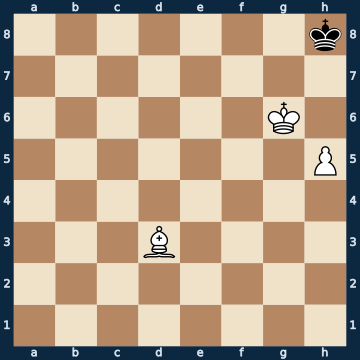
7k/8/6K1/7P/8/3B4/8/8 b - - 0 1The plan
A rook pawn and a bishop do not always win — this is the most famous draw of the minor-piece endgame. If the bishop does not have the colour of the queening square, the defending king simply sits down in the corner and cannot be dislodged. The picture behind it is always the same: the king shuttles between the corner and the square next to it, and as soon as the attacker takes away that last square too, it is stalemate instead of mate. In the final position of this line, fourteen of White's seventeen moves are exactly that — immediate stalemate. How dead the whole thing is shows in the entire sequence: over his four moves White has fourteen, seventeen, sixteen and seventeen options, and not a single one of these sixty-four moves wins. There is one condition to the rule, though, and it is a tight one: the defending king has to reach the corner in time. Measured for this position, it is exactly three squares — the corner square, the square next to it, and one further hold the draw, one square further out and White wins. What happens when the king arrives one tempo too late is shown in a separate lesson of this collection.
Rule of thumb: with a rook pawn, first check the colour of the queening corner — if it does not match your own bishop, the king belongs in the corner, and the defence needs nothing more.
Why this level: The wrong bishop: basic knowledge with an aha moment
The solution, move by move
- 1… Kg8 The only legal move — and the defender wants nothing more anyway. The king shuttles between the corner and the square next to it; the light-squared bishop can never attack the dark corner square h8 and so can never help drive it out of there.
- 2. Be4 White has fourteen moves to choose from here. None of them wins — and that holds at every single point in this line.
- 2… Kh8 Back into the corner, the only move that holds out of two. This exact square is the whole defence: as long as the king stands on it, the pawn cannot promote with check. Stepping aside loses at once (first sideline).Sideline 2… Kf8 The only way to still lose this draw: leave the corner. This is exactly where the rule's boundary lies — on this square only one of three moves still holds, and one square further out it is lost. 3. Kh7 The white king immediately occupies the corner itself. From here the pawn gets through, and the bishop's colour no longer matters. 3… Kf7 4. h6 Kf6 5. Kg8 The king makes way for the pawn, the rest is technique. Remember: it is not the bishop that saves the game, but the corner square.
- 3. h6 The pawn advances. It does not help White — later it only takes the square next to the corner away from the black king, and so works for the defence.
- 3… Kg8 Again the only move, and again one you do not have to calculate: make room and go straight back.
- 4. h7+ With check — the pawn places itself right next to the king. With the right bishop this would be the start of mate; here it is the start of stalemate.
- 4… Kh8 And back into the corner again, the only move that holds. One step aside, and the pawn promotes with check (second sideline).Sideline 4… Kf8 And even at the very last moment: a step to the side instead of staying put. 5. h8=Q+ The pawn promotes with check, because the corner square has become empty. As long as the king stands on h8, exactly this is impossible — that is the whole of the defence. 5… Ke7 6. Qh4+
- 5. Bd5 A waiting move, because White has nothing better. Of his seventeen moves, fourteen would be immediate stalemate (third sideline). The wrong bishop: same pawn, same king — only the bishop's colour has cost the whole point.Sideline 5. Kh6 STALEMATE, and here it can be seen up close. The black king has no square left: the white pawn on h7 covers g8, the white king covers g7, and it may not capture the pawn because the king protects it. Fourteen of White's seventeen moves end exactly this way. This is the reason the king cannot be forced out of the corner: the only path there leads through stalemate.
Play it yourself
In the free app C&C Chess Club you step through the line move by move, tap the sidelines and play the position out against Stockfish — no account, no ads.
More in Minor-piece endgames
- The right bishop — the same position wins White wins
- Opposite-coloured bishops — the blockade Draw
- The knight holds up the rook pawn Draw
- The wrong bishop — the corner has not been reached yet White wins
- The bishop against the rook pawn — one square on its path is enough Draw
- The bishop against two connected passed pawns Draw