 C&C Chess Club
The right bishop — the same position wins
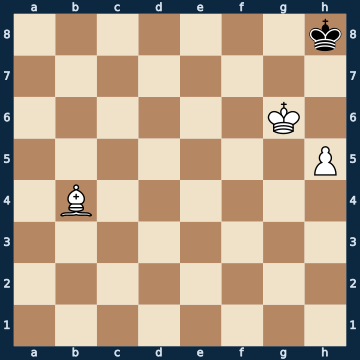
7k/8/6K1/7P/1B6/8/8/8 w - - 0 1The plan
The same position as with the wrong bishop, a single difference: the bishop now has the colour of the queening corner. That flips the result. The defending king may still sit down in the corner, only it is no longer a safe haven — the bishop sees the corner square from a distance, and what was stalemate a moment ago becomes mate at that very instant. The path there is as simple as an endgame can be: your own king already stands next to the pawn, the pawn takes two steps, the opponent has exactly one legal move after each of them, and then the bishop strikes home on the long diagonal. Nothing can be done wrong at the start: of the fifteen moves in the starting position, all fifteen win. At the end, though, the position is razor-sharp — there, out of fifteen moves, only one wins, and nine of the rest are immediate stalemate. Whoever knows the route but forgets the last diagonal gives away the whole point.
Rule of thumb: before any exchange into an endgame with a rook pawn and bishop, compare the colour of the queening square with the colour of your own bishop — same colour means won, different colour means a draw. You can decide that at the board in a second.
Why this level: The same position, the right colour
The solution, move by move
- 1. h6 The same plan as with the wrong bishop — only this time the corner is the right colour for the bishop. Out of fifteen moves, all fifteen win here; the pawn move is just the fastest of them.
- 1… Kg8 The only legal move. The white king covers g7 and h7, leaving only the square next to the corner.
- 2. h7+ With check, and again with no alternative for Black. The pawn places itself right next to the enemy king — with the wrong bishop this exact picture was the stalemate trap.
- 2… Kh8 The only move: back into the corner. With a light-squared bishop White would have been at the end of his options here.
- 3. Bc3# Mate instead of stalemate. The dark-squared bishop commands the long diagonal all the way into the dark corner, and this is the only winning move out of fifteen: nine of the rest give immediate stalemate (first sideline), and whoever moves the king instead loses the pawn (second sideline). A single detail — the bishop's colour — decides between the full point and the half point.Sideline 3. Bd6 STALEMATE — and the full point becomes a half point. The black king has no square left: the white pawn on h7 takes away g8, the white king the rest. Nine of the fifteen possible moves end exactly this way; whoever fails to mate here usually stalemates instead. This is exactly why the diagonal into the corner counts: it delivers mate in the same move.Sideline 3. Kf7 The second way to give away the point, and it looks quite sensible: the king steps aside to clear the square for the pawn. 3… Kxh7 The only move Black has — and it wins the pawn. The king had protected the pawn as long as it stood next to it; one step further away, and the pawn hangs. King and bishop alone do not mate: a draw.
Play it yourself
In the free app C&C Chess Club you step through the line move by move, tap the sidelines and play the position out against Stockfish — no account, no ads.
More in Minor-piece endgames
- The wrong bishop — rook pawn without the corner Draw
- Opposite-coloured bishops — the blockade Draw
- The knight holds up the rook pawn Draw
- The wrong bishop — the corner has not been reached yet White wins
- The bishop against the rook pawn — one square on its path is enough Draw
- The bishop against two connected passed pawns Draw