 C&C Chess Club
The wrong bishop — the corner has not been reached yet
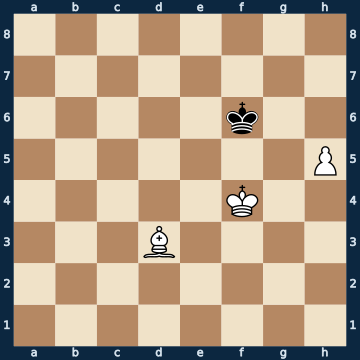
8/8/5k2/7P/5K2/3B4/8/8 w - - 0 1The plan
The wrong bishop does not save the game on its own — it only saves it if the defending king actually REACHES the queening corner. Here it is exactly one tempo too slow, and that is why only a single move wins: the pawn has to advance at once and block the black king's path into the corner. After that comes the second move with no alternative — the bishop places itself IN FRONT OF its own pawn and takes the last corner square away from the king. Only once the opponent is kept out may the white king set off; it goes round the defender by the side and seizes the square next to the pawn. Right at the end the bishop clears the file again, and the pawn goes through. Whoever moves the king first instead lets the opponent into the corner — and there, with the wrong bishop, never more than a half point can be won.
Rule of thumb: with the wrong bishop a single tempo decides — push the pawn and seal the corner first, then bring up the king.
Why this level: The wrong bishop only helps in time
The solution, move by move
- 1. h6 The ONLY winning move out of seventeen. The pawn takes the square g7 away from the black king, and with it the comfortable path into the corner. Every king move is one tempo too slow: the opponent reaches h8, and there a light-squared bishop can never drive it out (first sideline).Sideline 1. Kg4 The natural move — the king comes to help its pawn. And this is exactly what throws away the point: the black king was missing only one tempo, and it is given that tempo here as a gift. 1… Kg7 2. Kg5 Kh8 The king is in the corner, and from here on everything is over. A light-squared bishop never controls h8. 3. Kg6 Kg8 The only move — and it is enough. The king shuttles between g8 and h8 until stalemate. 4. h6 Kh8 A draw. An extra pawn and an extra piece, and still only a half point: this is the lesson 'The wrong bishop' from the basic tier.
- 1… Kf7
- 2. Bh7 Again with no alternative, and this time quite against instinct: the bishop places itself in front of its own pawn. It does this because from there it guards g8 — the last hole through which the black king could still slip into the death corner (second sideline).Sideline 2. Kg5 Even after the right pawn move it can still be spoiled: the king sets off instead of taking the square g8 away from the opponent. 2… Kg8 The only saving move — and it is available precisely because the bishop does not guard g8. 3. Kg6 Kh8 And again the only move, but it is enough: the king sits in the dark corner, a draw.
- 2… Kf8
- 3. Kg5 Only now the king. It can take its time, because pawn and bishop together keep the corner sealed.
- 3… Kf7
- 4. Kh5 The detour by the side. Going straight forward is not possible because the kings are in each other's way — so one step to the side and then past.
- 4… Kf8
- 5. Kg6
- 5… Ke7
- 6. Kg7 The king seizes the square next to the pawn and so covers everything the bishop previously had to hold on its own.
- 6… Ke8
- 7. Bg8 That is why the bishop may now move out of the way — onto a square its own king covers. The pawn's path is clear.
- 7… Ke7
- 8. h7
- 8… Ke8
- 9. h8=Q Promoted. The 'wrong' bishop has won, because the enemy king never made it into the corner — the whole point hung on a single tempo.
Play it yourself
In the free app C&C Chess Club you step through the line move by move, tap the sidelines and play the position out against Stockfish — no account, no ads.
More in Minor-piece endgames
- The knight holds up the rook pawn Draw
- The bishop against the rook pawn — one square on its path is enough Draw
- Opposite-coloured bishops — the blockade Draw
- The bishop against two connected passed pawns Draw
- The right bishop — the same position wins White wins
- The knight against two connected passed pawns Draw