 C&C Chess Club
The knight against two connected passed pawns
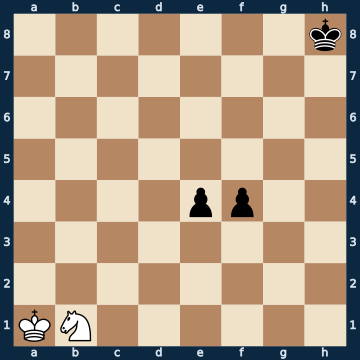
7k/8/8/8/4pp2/8/8/KN6 w - - 0 1The plan
The same task as with the bishop, only with the knight — and it is noticeably harder. The knight cannot seal off a diagonal; it has to get IN FRONT of the pawns and work square by square there. That is why it stands one rank further back here than the bishop in the sister lesson, and that is the lesson of this pair: what the bishop still holds, the knight loses in exactly the same pawn position. The route goes to the edge and back again, always to the square from which the next pawn advance can be answered. It picks up one pawn along the way, blocks the second, and at the end it even deliberately lets it queen — because it guards the queening square and scoops up the fresh queen at once. Whoever sets the knight up the wrong way round instead, or sends the king first, arrives one jump too late, and here one jump is enough to lose.
Rule of thumb: the knight has to get IN FRONT of the pawns, not behind them — and if it guards the queening square, the pawn may go ahead and queen.
Why this level: The knight has to get in front of the pawns
The solution, move by move
- 1. Na3 The knight goes to the edge to get forward via the corner. Two of the five moves lose at once: the wrong knight jump and the king move in the wrong direction (both sidelines).Sideline 1. Nc3 The knight jumps into the centre instead of to the edge — the active move, and the losing one. 1… e3 The only winning move, but an obvious one: the rear pawn runs and the knight does not stand in its way. 2. Nd5 e2 Again with no alternative and again easy to find. 3. Ne3 f3 4. Kb2 f2 The knight can only catch one of the two pawns. Two connected passed pawns on the third-to-last rank are too much for a knight — with the bishop in the sister lesson this exact position was still a draw.Sideline 1. Ka2 The king sets off on its long journey. It never arrives — the pawns are faster than any king crossing the board. 1… e3 Every pawn move is now the only winning move, and it is obvious. 2. Kb3 f3 3. Kc4 f2 4. Nc3 e2 Both pawns on the seventh rank, the knight alone in between: lost. It was the knight that should have set off at once, not the king.
- 1… e3
- 2. Nc2 The ONLY move that holds, out of seven. From here the knight attacks the front pawn on its next jump — every other square is one move too far away (third sideline).Sideline 2. Nc4 The knight heads for the centre instead of the square from which it reaches the front pawn. One square off — and lost. 2… e2 The pawn gets through. 3. Nd2 The knight comes back, but it cannot reach the queening square from here, 3… e1=Q+ and the pawn queens. With the knight it is not the direction that decides, but the exact square.
- 2… f3
- 3. Nxe3 Again the ONLY move: the knight takes the pawn nearest to it. Now only one is left, and a knight can hold up a single pawn too.
- 3… f2
- 4. Nf1 The knight places itself directly IN FRONT OF the pawn. It cannot be driven off this square — the black king stands at the other end of the board.
- 4… Kg8 Black has not a single useful move left; the king shuttles back and forth.
- 5. Ng3 And now the knight even voluntarily steps aside. The trick: from there it guards the queening square.
- 5… f1=Q+
- 6. Nxf1 The ONLY move that holds — and a very pleasant one: the queen is captured almost as soon as it appears. King and knight against the bare king, a draw.
Play it yourself
In the free app C&C Chess Club you step through the line move by move, tap the sidelines and play the position out against Stockfish — no account, no ads.
More in Minor-piece endgames
- The bishop against two connected passed pawns Draw
- Knight and rook pawn — the pawn must not go to a7 White wins
- The bishop against the rook pawn — one square on its path is enough Draw
- Same-coloured bishops — the king in front of the pawn holds Draw
- The wrong bishop — the corner has not been reached yet White wins
- The minor piece for the last pawn Draw