 C&C Chess Club
Same-coloured bishops — the king in front of the pawn holds
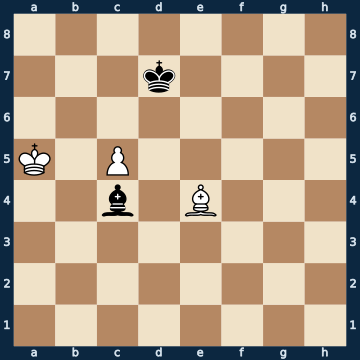
8/3k4/8/K1P5/2b1B3/8/8/8 b - - 0 1The plan
The basic defence in the bishop endgame with same-coloured bishops: your own king places itself directly in front of the extra pawn, and the bishop guards from a distance the diagonal the pawn would still have to cross. As long as the king stays there, the extra pawn is worth nothing, because the attacking king cannot get past it — it cannot stand next to it, and without help from its king the pawn does not take a single step. That is exactly why there is only a single move here that holds: the king has to go to the square in front of the pawn AT ONCE, otherwise it is cut off from it next move. After that it must not move again — in the whole main line every king move loses, and all the waiting work is done by the bishop. It only has to watch two things: staying on a diagonal that crosses the pawn's path, and not letting itself be traded off if the trade opens the way.
Rule of thumb: king in front of the pawn, bishop on the diagonal in front of it — and then wait, wait, wait.
Why this level: The fortress: king in front, and never move again
The solution, move by move
- 1… Kc7 The ONLY move that holds, out of seventeen. The king occupies the square in front of the pawn; every other square lets the white king past and loses. Even one step to the side or backwards is enough (sidelines).Sideline 1… Kd8 The king goes to the queening square instead of in front of the pawn — a whole rank too far back. 2. Kb6 The ONLY winning move, and it shows at once what the difference is: the white king gets past the black one and covers the square in front of the pawn. 2… Kc8 3. c6 Kd8 4. c7+ With check — the black king has to release the pawn for good. 4… Ke7 5. c8=Q Promoted. A single square on the first move has cost the point.
- 2. Kb4
- 2… Bg8 The bishop goes to the long diagonal, as far away from the white king as possible. Its own king must not move from now on — all four king moves lose here.
- 3. Kb5
- 3… Bf7 Again a pure bishop move; of the eleven possible moves only four hold, and all four are bishop moves. The king stays where it is.Sideline 3… Kd8 Even in the middle of the defence it stays the same: the moment the king leaves the square in front of the pawn, the fortress is gone. 4. Kb6 The white king immediately takes the vacated square and so covers the pawn's path. 4… Kc8 5. c6 Kd8 6. c7+ Kd7 7. Kb7 The king covers the queening square, the bishop can no longer intercept anything there — the pawn queens next move.
- 4. c6
- 4… Be8 The pawn has advanced, and the bishop places itself behind it — from there it attacks the pawn and forces White to keep defending it.
- 5. Bg6
- 5… Bd7 The attacker tries to drive the bishop off its diagonal. It simply steps one square further and guards the same path.
- 6. Bf5
- 6… Be8
- 7. Bd3
- 7… Bf7 And so it goes on endlessly. White has an extra pawn but not a single way forward — the king in front of the pawn is a fortress.
Play it yourself
In the free app C&C Chess Club you step through the line move by move, tap the sidelines and play the position out against Stockfish — no account, no ads.
More in Minor-piece endgames
- Knight and rook pawn — the pawn must not go to a7 White wins
- The minor piece for the last pawn Draw
- The knight against two connected passed pawns Draw
- Same-coloured bishops — trading off the blockading bishop White wins
- The bishop against two connected passed pawns Draw
- Same-coloured bishops — the short diagonal (Centurini) White wins