 C&C Chess Club
Same-coloured bishops — trading off the blockading bishop
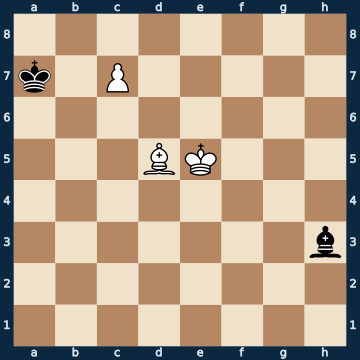
8/k1P5/8/3BK3/8/7b/8/8 w - - 0 1The plan
A pawn on the seventh rank, and the defender holds the queening square only with the bishop from a distance — his king stands in the corner and can no longer get close. Exactly then there is a recipe, and it is the only winning path out of twenty-two possible moves: your own bishop places itself RIGHT IN THE MIDDLE of the opponent's diagonal. From then on the defender has only two answers, and both lose. If he captures, his own king follows up and recaptures — the blockading piece is gone, and the pawn runs. If he does not capture, he simply loses the bishop next move anyway, because it can no longer step aside on the diagonal. Only one thing matters here: your own king has to stand next to the square the bishop goes to, otherwise the block is worth nothing. And the pawn itself must not run too soon — a queening square the enemy bishop guards is not a queening square.
Rule of thumb: don't chase the blockading bishop, interrupt it — right in the middle of the diagonal, with your own king next to it.
Why this level: Trading off the blockading bishop
The solution, move by move
- 1. Be6 The ONLY winning move out of twenty-two. The bishop places itself right in the middle of the diagonal along which the black bishop guards the queening square — on a square covered by the White king. Pushing the pawn immediately loses its point (first sideline), and if the king goes first, the block is worthless (second sideline). If Black takes the cheeky bishop, the blockade is gone (third sideline).Sideline 1. c8=Q The pawn wants to settle it on its own. The most obvious move in the position, and the worst. 1… Bxc8 The ONLY move that holds — and it is not hard to find. The black bishop has guarded this exact square from the very first moment; that is why the fresh queen did not live for even half a move. King and bishop against king and bishop of the same colour: a draw.Sideline 1. Kd6 The king goes first — it wants to protect the pawn. A move that would be right in almost any pawn endgame. 1… Kb6 And this is the refutation: the black king comes one step closer to the pawn. Nothing more is needed. 2. Be6 The same block as in the main line, just one tempo later. 2… Bxe6 The ONLY move that holds, and now it is correct: Black captures. 3. Kxe6 Kxc7 The ONLY move that holds — and the reason for everything. Because the black king stood on b6 instead of in the corner, it reaches the pawn in time. In the main line it was exactly one square too far away for that. King and bishop against the bare king — a draw.
- 1… Ka8 Black does not want to take the bishop — the king goes to the corner and hopes. But his own bishop is now stuck: it must not leave the diagonal, and it has nowhere left to go on it.Sideline 1… Bxe6 The other path: Black takes the bishop. That is not a mistake — it is the second half of the point. 2. Kxe6 The ONLY winning move out of ten, and this is exactly why the king was standing next to it. Had it been further away, the black bishop would simply have kept guarding the queening square. 2… Kb7 The black king comes out and attacks the pawn — its only try. 3. Kd7 The ONLY winning move: the king covers the queening square and at the same time takes the square in front of it away from the opponent. 3… Kb6 4. c8=Q Promoted. Whether Black captures or not only changes the path, not the result.
- 2. Bxh3 And it gets scooped up. That frees the queening square, and the rest is the simplest technique in all of endgame knowledge.
- 2… Kb7
- 3. Kd6 The king comes closer. It has to reach the square in front of the pawn, because the black king stands right next to it and would otherwise pick the pawn off.
- 3… Ka6
- 4. Kd7 Onto the square next to the pawn. From here it covers the queening square, and nothing more is needed.
- 4… Kb7
- 5. c8=Q+ Promoted, with check to boot. The whole win took five moves — but only because the first one was right.
Play it yourself
In the free app C&C Chess Club you step through the line move by move, tap the sidelines and play the position out against Stockfish — no account, no ads.
More in Minor-piece endgames
- The minor piece for the last pawn Draw
- Same-coloured bishops — the short diagonal (Centurini) White wins
- Same-coloured bishops — the king in front of the pawn holds Draw
- Wrong bishop — the direction of capture decides everything White wins
- Knight and rook pawn — the pawn must not go to a7 White wins
- Knight and pawn against knight — the pawn has to get past White wins