 C&C Chess Club
Knight and pawn against knight — the pawn has to get past
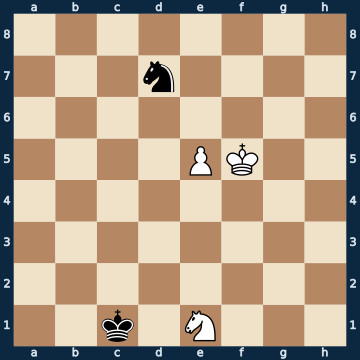
8/3n4/8/4PK2/8/8/8/2k1N3 w - - 0 1The plan
Knight and pawn against a knight only win as long as the pawn can still get past the enemy knight. Here it already stands in front of it and even attacks it — even so, the immediate advance is the only winning move. Any waiting move, any king move and any move of your own knight turns it into a draw, because the defender then pins the pawn down. After that the pawn stays put for a long time: it is not the pawn itself that has to push forward, but the king. It travels round the outside up to in front of the pawn and hunts the enemy knight, because a knight can only hold up a pawn from very specific squares. Your own knight follows up and takes away the last of these squares from the opponent; it finally attacks it, and with the exchange the way is clear. Only then does the pawn take its second step — and it can no longer be stopped. Whoever lets it run early instead loses it to the very knight waiting in front of it.
Rule of thumb: with a pawn against a knight, the first advance decides at once — after that the king pushes, not the pawn.
Why this level: Knight and pawn against knight: the pawn has to get past
The solution, move by move
- 1. e6 The ONLY winning move out of eleven. The pawn stands within the knight's reach and still — or precisely because of that — goes forward: it gets past the blocking square before the knight occupies it. If White waits even a single move, the pawn simply falls (first sideline).Sideline 1. Kg6 The king comes to help its pawn — a move that would be right in nine out of ten endgames. 1… Nxe5+ Not here: the knight takes the pawn with check. It had been standing there the whole time, and the king left it undefended by moving away. 2. Kf5 Nd7 Knight against knight, no pawns — a draw. A single waiting move has cost the whole point.
- 1… Nb6
- 2. Kg6 Again with no alternative, and again a move that seems to abandon the pawn. The king has to go round the outside; whoever pushes the pawn on instead loses it (second sideline).Sideline 2. e7 The pawn wants to manage it alone. This is the second major blunder of this endgame: without the king, a pawn on the seventh rank is only a target. 2… Nc8 The ONLY saving move — and it is obvious. The knight places itself in front of it and attacks it at the same time. 3. Kg6 Nxe7+ The pawn falls with check. This is why the king had to come up first and the pawn had to wait.
- 2… Nc8
- 3. Kf7 The third move in a row with no alternative. The king heads for the square next to the pawn, from which it can defend it later. The comfortable route via the other side lets the knight reach its blocking square (third sideline).Sideline 3. Kg7 One square off — the king goes past on the wrong side. That looks like the same route and is still only a draw. 3… Nd6 And this is the reason: from this square the knight guards both the queening square AND the square in front of it. After the right king move the knight does reach that square with check too, but then the white king attacks it next move and drives it off again — and exactly that is no longer possible from here.
- 3… Nb6
- 4. Ng2 Now the second knight comes into play too. It has a long way ahead of it, but there is enough time — the black king stands at the other end of the board and does not help its knight at all.
- 4… Nc8
- 5. Ke8 The king places itself on the queening square. From there it covers the square in front of the pawn and takes two squares away from the knight.
- 5… Nd6+
- 6. Kf8
- 6… Nc8
- 7. Nf4 The white knight heads for the square from which it can attack the black knight. From here Black no longer has a defence, only moves left.
- 7… Kd2
- 8. Nd5
- 8… Kd3
- 9. Nb6 The ONLY winning move out of thirteen. The knight attacks its counterpart — and because it stands on the only usable blocking square, it must not move away.
- 9… Nxb6 The natural move: Black trades off. All eleven moves lose, but this is the only one you find without calculating.
- 10. e7 The ONLY winning move out of six — and the pawn's second step of this game. Now there is no knight in the way any more, its own king covers the queening square, and the pawn goes through.
- 10… Kd4
- 11. e8=Q Promoted. Two pawn moves in eleven moves — in between only the king was working.
Play it yourself
In the free app C&C Chess Club you step through the line move by move, tap the sidelines and play the position out against Stockfish — no account, no ads.
More in Minor-piece endgames
- Wrong bishop — the direction of capture decides everything White wins
- Knight and pawn against bishop — the sacrifice distance White wins
- Same-coloured bishops — the short diagonal (Centurini) White wins
- Same-coloured bishops — the sixth rank decides White wins
- Same-coloured bishops — trading off the blockading bishop White wins
- Wrong bishop — two h-pawns are worth as much as one Draw