 C&C Chess Club
Knight and pawn against bishop — the sacrifice distance
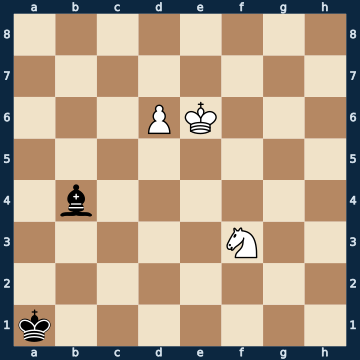
8/8/3PK3/8/1b6/5N2/8/k7 w - - 0 1The plan
Knight and pawn against a bishop are only won if the bishop cannot give itself up for the pawn in time. This is exactly what it is about from the very first second here: the bishop is attacking the pawn right now, and only the immediate advance holds the win — out of sixteen moves, not a single other one wins. After that the defender looks for the diagonal on which he reaches the queening square, and he finds it too. He cannot be driven off it by attacks, only by zugzwang: king and knight take away his squares one by one, until he has to place himself on the queening square himself and is captured there. For this the knight needs a square from which it reaches the queening square, and the king has to cover it while doing so. How narrow this is shows in the counter-test: the very same set-up with the pawn one file further out is a clean draw, because the bishop then has one more diagonal.
Rule of thumb: the defender gives up the piece for the pawn — so first push the pawn through, then use zugzwang to drive the bishop off its diagonal.
Why this level: The sacrifice distance against the bishop
The solution, move by move
- 1. d7 The ONLY winning move out of sixteen. The pawn stands within the bishop's reach; whoever leaves it there for even one move loses it and with it the point (first sideline).Sideline 1. Kd5 The king wants to defend the pawn. One move too late. 1… Bxd6 The ONLY move that holds, and the most obvious one in the position: the bishop simply takes the pawn. This is the defender's resource in EVERY endgame with a minor piece against a pawn. 2. Kxd6 King and knight against the bare king — there is no mate, a draw.
- 1… Ba5 The bishop switches to the diagonal leading to the queening square. It has exactly one for this — with the pawn one file further out it would have two, and then the position would be a draw.
- 2. Kd5 The king comes closer. Only five of nineteen moves keep the win: the pawn is now on the seventh rank and needs cover, otherwise the bishop picks it off after all.
- 2… Bd8
- 3. Kc4
- 3… Be7
- 4. Ne5 Now the knight. It looks for the square from which it reaches the queening square itself — only there can it later intercept the bishop. Whoever sends it into the open instead gives up the win (second sideline).Sideline 4. Ng5 The knight jumps into the open instead of towards the queening square. It looks active, but it moves away from the one spot where it is needed. 4… Bf6 The bishop settles on the long diagonal. From there it sees the queening square, and nobody can drive it off. 5. d8=Q Bxd8 The queen is gone again at once. Knight against bishop with no pawns — a draw.
- 4… Bd8
- 5. Nc6 Arrived. From here the knight covers the queening square, and the bishop has to look for another spot on its diagonal.
- 5… Bc7
- 6. Kb5 And now the king comes round to the other side. This is the real plan: to squeeze the bishop's diagonal so tight that in the end only a single square is left for it.
- 6… Kb2
- 7. Ka6
- 7… Kc3
- 8. Kb7 The final move of the zugzwang — only three of fifteen moves still keep the win. The king places itself next to the bishop and takes away everything but one square (third sideline).Sideline 8. Nd8 The knight occupies the queening square itself. That is one square too early: it is meant to CAPTURE there, not stand on it. 8… Bxd8 Because now the bishop captures, and the pawn is left standing alone. 9. Kb7 Be7 The bishop guards the queening square again from a distance. Without the knight the pawn never gets through — a draw.
- 8… Bd8 And that happens to be the queening square. The bishop has to stand in front of it, otherwise the pawn goes through at once.
- 9. Nxd8 The ONLY winning move out of thirteen — and this is exactly why the knight stood on this square. The bishop is gone, and the pawn has a clear path.
- 9… Kd4
- 10. Nf7 The knight clears the path and keeps covering the queening square from its new square.
- 10… Kd5
- 11. d8=Q+ Promoted. The whole win consisted of two pawn moves and a long stretch of zugzwang work by king and knight.
Play it yourself
In the free app C&C Chess Club you step through the line move by move, tap the sidelines and play the position out against Stockfish — no account, no ads.
More in Minor-piece endgames
- Knight and pawn against knight — the pawn has to get past White wins
- Same-coloured bishops — the sixth rank decides White wins
- Wrong bishop — the direction of capture decides everything White wins
- Wrong bishop — two h-pawns are worth as much as one Draw
- Same-coloured bishops — the short diagonal (Centurini) White wins
- Rook pawn with knights — the king has to reach the corner Draw