 C&C Chess Club
Wrong bishop — two h-pawns are worth as much as one
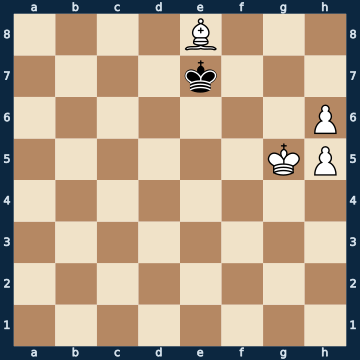
4B3/4k3/7P/6KP/8/8/8/8 b - - 0 1The plan
White has an extra pawn, and this extra pawn is not worth a penny. Both pawns stand on the h-file, and the bishop runs on light squares, while the queening square in the corner is dark. Take the rear of the two pawns off the board entirely and nothing changes about the result: the same evaluation, the same single saving move — measured. Put the very same pawn on a different file instead, and White wins; checked on the a-, b-, d-, f- and g-files, and every single time Black then loses with every one of his moves. Even so, the draw is not a gift: out of five possible king moves exactly one holds, and it is not the one that scoops up the bishop. Whoever takes the piece ends up richer in material and exactly one step too far from the corner. If White then uses the bishop to take away the square in front of the pawn from the defender, only two moves are left to him, and again only the one forward holds alone. In the end the black king stands on the queening square, and White's best try ends in stalemate.
Rule of thumb: with the wrong bishop never capture towards a doubled pawn — two pawns on the h-file count as one, the same pawn one file over would be the whole win.
Why this level: Warns against capturing towards a doubled pawn — an extra pawn worth nothing
The solution, move by move
- 1… Kf8 The ONLY move that holds, out of five. The bishop stands there for the taking, and that is exactly the trap: whoever captures it has won a piece and lost a tempo, and here the tempo is the whole endgame (first sideline). Every step back towards the centre of the board loses too. Only the path to the corner holds, and the corner is h8 — the square the light-squared bishop can never set foot on.Sideline 1… Kxe8 The bishop hangs, and it is the wrong one anyway — so why not grab it? Because the move does not gain time, it costs a tempo. After it Black is a whole piece richer and loses. 2. Kg6 The king goes in front of its pawn and takes away the squares the defender wanted to use to reach the corner. 2… Kf8 The black king would like to go to g7, but there it stands under watch. It can no longer reach the corner. 3. h7 The ONLY winning move out of five: the pawn advances at exactly the moment the black king is allowed to step onto neither g7 nor g8. 3… Ke7 There is nothing left. 4. h8=Q Promoted. Black still has the extra piece, it just does not help him.
- 2. Bg6 White tries the only sensible thing: the bishop takes the square in front of the pawn away from the black king while covering the advance at the same time. Together with White's own pawn, which guards g7, the defender is left with only two squares.
- 2… Kg8 Again the ONLY move that holds, this time out of two. Going back is no longer possible — then the pawn runs through (second sideline). The king has to continue towards the corner, even though it walks into a check there.Sideline 2… Ke7 Back out of the squeeze — the most natural move in the world, and the loss. Of the two remaining squares only the one forward holds. 3. h7 Now the pawn goes, because the king can no longer catch up with it. 3… Kf8 One step too late. 4. h8=Q+ Promoted, with check to boot.
- 3. h7+ With check, and White has thereby achieved everything there was to achieve: pawn on the seventh rank, covered by the bishop, the second pawn in reserve behind it. Only the queening square is dark and the bishop is light-squared — nobody can guard it.
- 3… Kh8 Here, exceptionally, two moves hold; the one into the corner is the simpler one. Standing on the queening square is the whole trick: as long as the king sits there, the pawn cannot get through, and it cannot be driven off. Choosing the square next to it instead loses at once (third sideline).Sideline 3… Kf8 The square next to the corner looks just as safe as the corner itself. It is not. 4. h8=Q+ At once and with check. Only the king ON the queening square holds up the pawn — that is why it goes into the corner and nowhere else.
- 4. Kf6 Stalemate. White cannot bring the king any closer without taking away the opponent's last move — with the wrong bishop, nothing more than this is ever possible. This exact picture is the reason the second h-pawn is worth nothing: it stands behind the first one and never comes into play.
Play it yourself
In the free app C&C Chess Club you step through the line move by move, tap the sidelines and play the position out against Stockfish — no account, no ads.
More in Minor-piece endgames
- Same-coloured bishops — the sixth rank decides White wins
- Rook pawn with knights — the king has to reach the corner Draw
- Knight and pawn against bishop — the sacrifice distance White wins
- Knight against separated passed pawns — the double square Draw
- Knight and pawn against knight — the pawn has to get past White wins
- Opposite-coloured bishops — two extra pawns aren't enough Draw