 C&C Chess Club
Rook pawn with knights — the king has to reach the corner
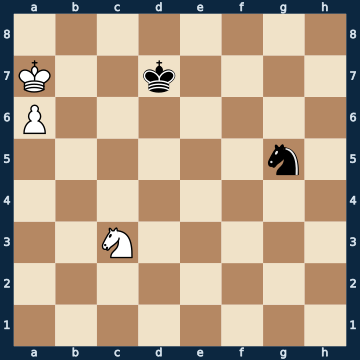
8/K2k4/P7/6n1/8/2N5/8/8 b - - 0 1The plan
A rook pawn remains a draw even when both sides have a knight — provided the defending king reaches the corner IN FRONT OF the pawn in time. Here, in time means literally that: out of fourteen possible moves exactly one holds, and it is the king's step onto the file next to the pawn. How narrow this is shows in the counter-picture — if the defending king stood just one file further out, the position would already be lost before anyone could even make a mistake; and if the pawn stood one rank further back, the matter would be harmless, then five of fourteen moves would hold. The next move repeats the very same law: again only one of nine moves is correct, and again it is the step further into the corner. Only once the king has arrived on b8 may the knight have its say again — and then it has to. For White has exactly one try: to place his knight on c7, where it guards the queening square and is protected by its own king. There is a single defence against this, and it costs the defender's own knight — it has to capture the intruder, even though it falls itself in doing so. After that everything is mere bookkeeping: the pawn promotes with check, and the fresh queen is scooped up again in the same breath.
Rule of thumb: with a rook pawn it is not material that counts but a single square — the king belongs in the corner, and the knight pays for the rest.
Why this level: The rook pawn exception once more, now with pieces on both sides
The solution, move by move
- 1… Kc8 The ONLY move that holds, out of fourteen. The king has to go to the file next to the pawn, because only from there can the corner be reached in one further step. Everything else is one tempo too slow — even the seemingly more purposeful Kc7, which looks closer and still loses (first sideline).Sideline 1… Kc7 The king goes to meet the pawn and appears to stand closer than it would on the neighbouring file. This is exactly the mistake. 2. Nd5+ And this is the refutation — one of only two winning moves. The knight check drives the king off, and with it White wins exactly the tempo he was missing: before this, his own king could not step aside at all, because the black king stood too close to it. 2… Kd8 3. Kb7 Now it works. The king makes room for the pawn and covers the queening square at the same time. 3… Ke8 4. a7 The pawn runs, and the black king is locked out. The knight no longer reaches the edge in time. 4… Kf8 5. a8=Q+ Promoted. A single square on the first move made the whole difference.
- 2. Kb6 White first has to clear the square for his own pawn: as long as his king stands in front of the pawn, it cannot move at all. The step to b6 clears the square and comes closer at the same time.
- 2… Kb8 Again the ONLY move that holds, this time out of nine. The same law as before, just one square further: the king belongs in front of the pawn. From b8 it covers a7 and a8 at once, and it can no longer be driven off from here.
- 3. Nd5 The only plan that promises anything at all. The knight sets off for c7 — there it would guard the queening square, and the pawn could run through with check.
- 3… Ne6 The ONLY move that holds, out of eight. The knight has to come back, and specifically to the one square from which it reaches c7. Any other retreat is too far away, however close it may look (second sideline).Sideline 3… Nf7 The knight stays close, but on the wrong side: from f7 it cannot reach c7. Closeness alone is no help to a knight — all that counts is which squares it reaches in one move. 4. Nc7 Now the knight may go to c7. It covers a8 and is protected by its own king, so it is untouchable. 4… Kc8 5. a7 The ONLY winning move out of eleven. The pawn goes to the seventh rank and cannot be stopped, because the knight guards the queening square. 5… Kd8 6. Ne8 The deflection sacrifice: the knight clears the eighth rank by offering itself. If Black does not capture, the pawn promotes at once. 6… Kxe8 7. a8=Q+ Promoted, with check. The black knight has been watching from the wrong side of the board the whole time.
- 4. Nc7 White places the knight there anyway. It is protected by the king — a gift with a catch.
- 4… Nxc7 The ONLY move that holds, out of nine. It has to be taken, even though Black's own knight goes with it: if the white knight stayed on c7, the pawn would run through with check and the queening square would be covered (third sideline). A knight that holds up a rook pawn is not a loss, it is a price worth paying.Sideline 4… Nc5 Black wants to save his own knight instead of capturing the enemy one. Understandable, and thought through exactly backwards. 5. a7+ The ONLY winning move out of ten, and it comes with check. Because the white knight on c7 guards the queening square, the pawn can no longer be stopped. 5… Kc8 Forced — there is no second square for the king. 6. Kc6 Kd8 7. Ne8 The deflection sacrifice again. The knight clears the eighth rank, and Black has to capture. 7… Kxe8 8. a8=Q+ Promoted. The knight on c5 was not guarding anything the whole time — that is why it had to capture rather than flee at the decisive moment.
- 5. a7+ Check — the king has to come out of the corner, and the pawn gets its queening square freed.
- 5… Kc8 Both king moves hold. This one invites White to promote; Ka8 would draw just as well, only less spectacularly, because then the pawn does not even get through in the first place.
- 6. a8=Q+ White promotes with check and has an extra queen for half a move.
- 6… Nxa8+ The ONLY move that holds — and the whole reason the knight had to land on c7 earlier. The fresh queen falls at once, with check to boot. What remains is a bare king and a knight: a draw for lack of material.
Play it yourself
In the free app C&C Chess Club you step through the line move by move, tap the sidelines and play the position out against Stockfish — no account, no ads.
More in Minor-piece endgames
- Wrong bishop — two h-pawns are worth as much as one Draw
- Knight against separated passed pawns — the double square Draw
- Same-coloured bishops — the sixth rank decides White wins
- Opposite-coloured bishops — two extra pawns aren't enough Draw
- Knight and pawn against bishop — the sacrifice distance White wins
- Opposite-coloured bishops — two separated passed pawns win White wins