 C&C Chess Club
Opposite-coloured bishops — two separated passed pawns win
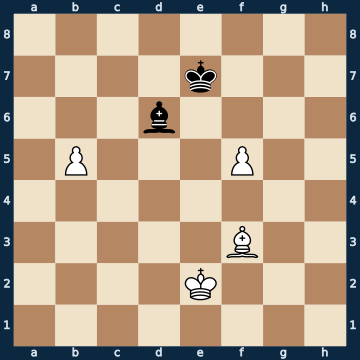
8/4k3/3b4/1P3P2/8/5B2/4K3/8 w - - 0 1The plan
Opposite-coloured bishops are considered a guaranteed draw, and with one extra pawn that is indeed true. With two passed pawns it comes down to the distance between them: the defender has exactly two guards, the king and the bishop, and the moment each passed pawn needs its own guard, nobody is left to prevent anything. Here the pawns lie four files apart, and that is enough: out of eighteen white moves, sixteen keep the win. The two exceptions are, of all things, the two pawn advances — making progress here throws away the whole point. The reason is the square colour: both pawns stand on the colour of your own bishop, where the enemy bishop can never touch them; every advance puts them on the opponent's colour. With the kingside pawn there is the added factor that the advance hands the enemy king the square directly in front of it, from which it can never again be dislodged — bishop and this pawn against the king in front of it is, measured, a draw, one rank earlier, measured, a win. How far apart the pawns have to be, I have counted out: at a distance of two files the defender still holds by placing the bishop between the pawns and taking away the advance square from both — from three files apart, that one square no longer exists. Connected passed pawns are a different story again and have their own lesson; out of twelve hundred random positions with this material, the defender saves himself in two out of a hundred at a distance of four files, and in twenty-four out of a hundred with pawns standing side by side.
Rule of thumb: two widely separated passed pawns win against opposite-coloured bishops — but only as long as they stay put and the king comes.
Why this level: The exception to the drawing rule — and the two advances that ruin it
The solution, move by move
- 1. Ke3 The king sets off, and the pawns stay put. Sixteen of the eighteen moves keep the win; the two exceptions are the sidelines at the end — exactly the two pawn advances.Sideline 1. f6+ The most natural move in the position: an advance with check. And it throws away the win. At first quite plainly, because the pawn on f6 is undefended by anybody and may simply be captured. The deeper reason follows in the next move. 1… Kf7 One of only three moves that hold — and the instructive one. Black does not take the pawn at all, he stands in front of it. The king can never be dislodged from this square: the queening square has the colour of the BLACK bishop, so the white bishop can never cover it, and its own pawn takes away the two squares next to the king. Measured: bishop and pawn on f6 against the king in front of it is a draw, the same position with the pawn one rank further back is won. This one rank is exactly what the advance gave away. 2. b6 White tries it on the other side. 2… Bf4 The bishop stays on the diagonal to the queening square. It does not need to do anything more. 3. b7 The pawn gets as far as the seventh rank and not a step further. 3… Bd6 Done. The king holds one passed pawn, the bishop the other, and the white king gets nowhere any more. Exactly the division of labour White handed over with a single move.Sideline 1. b6 The second advance, the same mistake in a different colour. On b5 the pawn stood on a light square — unreachable for the black bishop. On b6 it stands on a dark square and is fair game from now on; only the king can defend it, since its own bishop never sets foot on that colour. 1… Bc5 One of six moves that hold, and the clearest one: the bishop attacks the pawn while continuing to guard the kingside queening square from the same diagonal. 2. Kd3 The king hurries to help — it is the only one that can. Except it is three steps too far away. 2… Kd7 Black does not even need to hurry. 3. Kc4 One step too late. 3… Bxb6 The ONLY move that holds, and it is not hard to find. One pawn down, opposite-coloured bishops, a single passed pawn — this is the drawing rule in its purest form.
- 1… Kf6 Black places the king in front of the passed pawn and attacks it in passing. The bishop can never attack this pawn, since it stands on the wrong colour; the king, however, can.
- 2. Ke4 Only three of the eighteen moves still keep the win now, and all three do the same thing: they defend the attacked pawn. Whoever forgets this loses it and with it everything (third sideline).Sideline 2. Kd3 The king marches on as if nothing were happening. Except the kingside pawn is under attack right now, and fifteen of the eighteen moves abandon it. 2… Kxf5 The ONLY move that holds — and Black does not have to search for long. With only one passed pawn left, the defender again has a guard to spare, and opposite-coloured bishops are then what they are famous for: a draw.
- 2… Kf7
- 3. Bg4 Now the bishop takes over the defence of the pawn, and the king is free. This is the division of labour for the whole endgame: one piece holds the kingside together, the king goes to the other side.
- 3… Kf6
- 4. Kd5 The king marches to the queenside and in doing so attacks the square the black bishop stands on. This square is the only one from which it guards BOTH queening squares — that is why it has to be taken away from it.
- 4… Bc7 The bishop gives way while staying on the long diagonal to the queenside pawn's queening square. From now on it must never leave this diagonal again.
- 5. Kc6 Again with an attack. Of eleven moves only six keep the win here — the king has to go next to the pawn, otherwise it is never allowed further.
- 5… Bh2
- 6. b6 Only NOW is the advance correct. The pawn does step onto a dark square, but its own king stands right next to it and protects it. This is exactly what was missing on the first move: measured, in the starting position this advance only wins once the white king has reached c4, d4 or d5 — from the starting square it is a draw.
- 6… Bg3
- 7. Kb7 The king goes round its own pawn. The target is a7 — from there it covers the queening square, and the black bishop cannot disturb it there.
- 7… Bf4
- 8. Ka7 Arrived. Black has nothing but waiting moves: the king must not lose sight of the kingside passed pawn, the bishop must not leave the diagonal. Two guards, two pawns, no reserve.
- 8… Be5
- 9. b7 The pawn goes to the seventh rank. The bishop still guards the queening square — but the white king guards it too, and that decides it.
- 9… Bd6
- 10. b8=Q The point of the whole march. The queen is captured at once, and that is intentional: the passed pawn is traded for the bishop.
- 10… Bxb8+ Forced. If Black leaves the queen standing, the game is over immediately.
- 11. Kxb8 The ONLY move that still wins — and the reward for all the work. White has a bishop and a passed pawn against the bare king, and the pawn still stands on its light square. Had White pushed it forward on the first move, this exact position would be a draw (first sideline).
Play it yourself
In the free app C&C Chess Club you step through the line move by move, tap the sidelines and play the position out against Stockfish — no account, no ads.
More in Minor-piece endgames
- Opposite-coloured bishops — two extra pawns aren't enough Draw
- Two knights against a pawn — won and still a draw White wins
- Knight against separated passed pawns — the double square Draw
- Knight against bishop — the fixed chain on one colour White wins
- Rook pawn with knights — the king has to reach the corner Draw
- The bad bishop — pawns on your own colour White wins