 C&C Chess Club
The bad bishop — pawns on your own colour
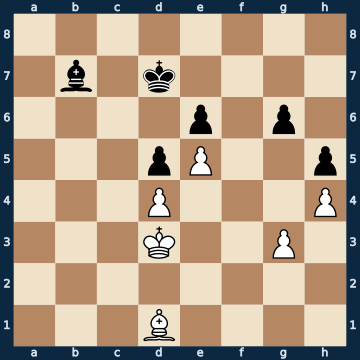
8/1b1k4/4p1p1/3pP2p/3P3P/3K2P1/8/3B4 w - - 0 1The plan
Both bishops are light-squared — and yet one is a piece and the other a spectator. White has put all his pawns on dark squares, Black all of his on light squares. That makes every black pawn a possible target for the white bishop, while not a single white pawn can even be looked at by the black bishop. White is in no hurry: the king goes to the centre first, because Black has nothing with which to interfere. Then the bishop takes the long light diagonal to the kingside and attacks the pawn on g6 there, which the black bishop would only reach after two moves. Black is left with only the advance, which breaks up his own chain and costs a pawn; shortly afterwards the second one falls too.
Rule of thumb: put your pawns on the OPPOSITE colour to your bishop — otherwise you will be playing a piece down for the long run.
Why this level: The winning path is not sharp, but you have to correctly judge the value of the pawns' colour and give the bishop the right diagonal, rather than just charging off with the king.
The solution, move by move
- 1. Ke3 No hurry. Black has no move anywhere on the board that improves anything — so White may put his king in the centre first.
- 1… Bc8
- 2. Bc2 The heart of this lesson: the light-squared bishop heads for the light pawn on g6. Only the black bishop could defend it, and that takes two moves via d7 and e8 — it does not have the time.
- 2… g5 Black would rather push the pawn forward than lose it standing still. But that breaks up the chain, and that is exactly what must never happen to the defender.Sideline 2… Ke7 Wait calmly and first clear the square d7 for the bishop, so it can defend the pawn via e8 — except that takes two moves, and White does not give that much time. 3. Bxg6 This is exactly why the advance was forced: here the pawn simply falls, and the next one is already standing right next to it.
- 3. hxg5 Recapturing. The advance has only changed the square on which the pawn falls.
- 3… Ba6
- 4. Bg6 The bishop places itself in front of the rest of the wing and takes aim at h5. On the light squares the board belongs to White alone.
- 4… Bf1
- 5. Bxh5 The second pawn falls. White now has two extra pawns as well as the clearly better piece — the black bishop has not had a single target throughout the whole lesson.
- 5… Ke7
Play it yourself
In the free app C&C Chess Club you step through the line move by move, tap the sidelines and play the position out against Stockfish — no account, no ads.
More in Minor-piece endgames
- Knight against bishop — the fixed chain on one colour White wins
- Two knights against a pawn — won and still a draw White wins
- Opposite-coloured bishops — two separated passed pawns win White wins
- Opposite-coloured bishops — two extra pawns aren't enough Draw
- Knight against separated passed pawns — the double square Draw
- Rook pawn with knights — the king has to reach the corner Draw