 C&C Chess Club
Knight against bishop — the fixed chain on one colour
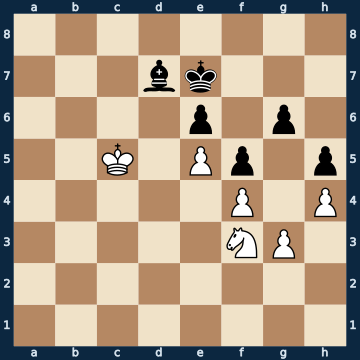
8/3bk3/4p1p1/2K1Pp1p/5P1P/5NP1/8/8 w - - 0 1The plan
All four black pawns stand on light squares — exactly the colour of Black's own bishop. It cannot defend a single one of them, and it cannot get in front of the chain either. The knight, by contrast, works on the dark squares, which nobody disputes with it. On the kingside the position is tightly interlocked, and there is no breakthrough there. The queenside, however, is completely empty, and the white king marches in there over nothing but dark squares — the light-squared bishop cannot deny it a single one of them. Once the king is in, Black has no useful move left and has to break up his own chain himself. After that the knight swings round over the dark squares and picks up the pawn on e6, the foundation stone of the whole chain.
Rule of thumb: a closed position, your own pawns on the bishop's colour, play on only one wing — then the knight is the better piece.
Why this level: A pure assessment lesson: the winning path is not sharp, but you have to recognise that the king marches in on the empty wing and the bishop is powerless against it.
The solution, move by move
- 1. Kb6 The king goes to where the opponent has nothing standing. b6 and c7 are dark squares, and a light-squared bishop can never control them — the march-in simply cannot be stopped with this piece.
- 1… Ba4 The bishop flees behind its own chain and heads for the long light diagonal. That only takes it even further from the action.
- 2. Kc7 King first, then the piece. As long as the knight stands quietly, Black has not a single point of attack.
- 2… g5 Zugzwang: Black has no move left that does not spoil something, and breaks up his own chain. Waiting quietly loses just as much.
- 3. fxg5 Capture, don't push. White opens the dark squares and does not give the bishop a single new diagonal in the process.
- 3… Be8
- 4. Nd4 Only now may the knight set off, and this is the heart of the position: if it goes too early, it gives up its watch behind its own chain, the bishop escapes onto the long diagonal and holds everything together from there — worked out, the position is then equal. King first, then the piece. But now its route via dark squares leads to the light pawn on e6 — exactly the pawn the bishop can never defend.
- 4… Ba4
- 5. Nc6+ With tempo: the knight strikes into the centre and drives the king off e7.
- 5… Ke8
- 6. Kd6
- 6… Bb5
- 7. Nd4
- 7… Bd3
- 8. Nxe6 The foundation stone of the chain falls. The passed pawn on e5 now costs the bishop, and the endgame is decided.
Play it yourself
In the free app C&C Chess Club you step through the line move by move, tap the sidelines and play the position out against Stockfish — no account, no ads.
More in Minor-piece endgames
- Two knights against a pawn — won and still a draw White wins
- The bad bishop — pawns on your own colour White wins
- Opposite-coloured bishops — two separated passed pawns win White wins
- Opposite-coloured bishops — two extra pawns aren't enough Draw
- Knight against separated passed pawns — the double square Draw
- Rook pawn with knights — the king has to reach the corner Draw