 C&C Chess Club
The bishop against two connected passed pawns
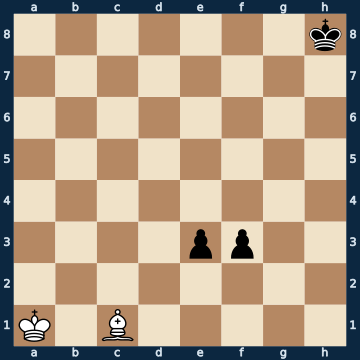
7k/8/8/8/8/4pp2/8/K1B5 w - - 0 1The plan
For a single piece, two connected passed pawns are the most dangerous form of material, because they cover each other and the piece can only hold up one of the two. Here the bishop manages it anyway — but only if it strikes at once. It takes the pawn standing on ITS OWN colour, and keeps the other one covered on the diagonal that crosses its path. From then on the matter is settled: the remaining pawn can never advance without being captured, and the bishop has enough squares on its diagonal to wait on. It only has to keep out of the enemy king's way, because this one bishop must not be allowed to be taken. In the end it gives itself up voluntarily for the last pawn — bare kings, a draw. One tempo later, with the pawns one rank further on, the very same position would be lost.
Rule of thumb: against two connected passed pawns, take one at once — the one on your own colour — and hold the other on the diagonal.
Why this level: Capture at once instead of attacking
The solution, move by move
- 1. Bxe3 The ONLY move that holds, out of seven. It looks like a simple exchange but is an exact choice: the pawn captured is the one on the bishop's own colour, because the bishop then holds up the second pawn from that very same diagonal. Whoever only attacks instead of capturing loses his bishop to the same pawn (first sideline); whoever brings up the king first comes too late (second sideline).Sideline 1. Bd2 The bishop attacks the pawn instead of taking it. That looks like the same idea, but it is an entirely different move. 1… exd2 Because the pawn captures first. Connected passed pawns do not just cover each other — they capture as well. 2. Kb2 d1=Q And promote. The bishop is gone, the game is gone.Sideline 1. Kb2 The king sets off — a sensible idea in almost any endgame, but far too slow here. 1… f2 The pawn runs, and the bishop can no longer catch up with it. 2. Bxe3 Now the bishop may take the other pawn, 2… f1=Q but the first one promotes — and that is the ONLY winning move, so every opponent finds it. A piece can only hold up ONE pawn; that is why the exchange had to happen at once.
- 1… Kg7
- 2. Kb2 The king may set off at its leisure — the blockade is handled by the bishop alone.
- 2… Kg6
- 3. Kc3
- 3… Kh5
- 4. Kd3
- 4… Kg4
- 5. Bg1 The bishop goes along the diagonal into the corner, out of the way of the advancing king. Only one thing matters: it must never leave this diagonal, because it crosses the pawn's path.
- 5… Kg3
- 6. Ba7 Another waiting move on the same diagonal, this time to the other end. The black king comes closer, so the bishop moves further away.
- 6… Kg2
- 7. Bd4
- 7… f2 Finally the advance — Black never had more than this.
- 8. Bxf2 And the ONLY move that holds: the bishop gives itself up for the last pawn. This is exactly what it stood on this diagonal for the whole game. What remains are two bare kings — two pawns against a piece, and still only a half point for both.
Play it yourself
In the free app C&C Chess Club you step through the line move by move, tap the sidelines and play the position out against Stockfish — no account, no ads.
More in Minor-piece endgames
- The bishop against the rook pawn — one square on its path is enough Draw
- The knight against two connected passed pawns Draw
- The wrong bishop — the corner has not been reached yet White wins
- Knight and rook pawn — the pawn must not go to a7 White wins
- The knight holds up the rook pawn Draw
- Same-coloured bishops — the king in front of the pawn holds Draw