 C&C Chess Club
Opposite-coloured bishops — the blockade
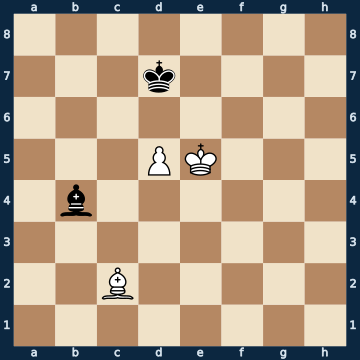
8/3k4/8/3PK3/1b6/8/2B5/8 b - - 0 1The plan
White has an extra pawn and still cannot budge — this is the most common drawing pattern in the whole of the endgame. Behind it lies a division of labour: the black bishop guards the dark square in front of the pawn from a distance, the black king occupies the light square behind it — each takes one square colour. The white bishop does not have the colour of the blockade square: it can attack nothing there, defend nothing, and can never drive off its counterpart. That leaves the white king, and a king cannot work on both square colours at once — so neither of the two can be overloaded. The defender simply waits and, if need be, gives up the bishop for the pawn. How comfortable this is, the measurement shows: in the starting position all fourteen moves hold the draw, and in the whole line exactly one black move loses. Without the bishop, on the other hand, White wins at once, even with the king still standing in front of the pawn. And a second extra pawn changes nothing: four set-ups with it have been checked, all four stay drawn — a separate lesson in this collection follows that up.
Rule of thumb: with opposite-coloured bishops, build the blockade on your own square colour — and only count on winning once the material gap is large.
Why this level: Opposite-coloured bishops: the blockade
The solution, move by move
- 1… Ba3 A waiting move that keeps the diagonal to the blockade square d6. The bishop can shuttle back and forth on it as often as it likes — the blockade costs it no tempo, and that is exactly why the defender never runs into zugzwang. All fourteen moves in the position hold the draw.
- 2. Kf6 The white king looks for a way round the blockade. There is none: the pawn needs the dark square in front of it, and dark squares are exactly the ones the white bishop can never reach.
- 2… Bb4
- 3. Ke5 And back again. White has no winning move anywhere in this line — the king may wander wherever it likes.Sideline 3. d6 The obvious attempt to force the extra pawn through. 3… Bxd6 It is simply taken. With opposite-coloured bishops the defender guards his blockade square from any distance, and the white bishop can never help the pawn there. 4. Kf5 Bb4 Bishop against bishop with no pawns: a draw. The advance has to be prepared, otherwise it is a gift.
- 3… Ba3
- 4. Ba4+ White never has more than a check: the king steps aside, everything stands as before.
- 4… Kd8
- 5. Ke6 The king takes up a position beside the pawn. That lets it defend the pawn, but it does not move things forward — in front of the pawn stands the black king, and on the diagonal to it the black bishop.
- 5… Bb4 The bishop goes back to its diagonal. Here the only losing move of the whole line is on offer: putting the bishop directly on the blockade square instead of guarding it from a distance (second sideline). Of nine moves, eight hold.Sideline 5… Bd6 The bishop tries to occupy the blockade square even more firmly — and in doing so plants itself right under the white king's nose. 6. Kxd6 The bishop holds d6 from a DISTANCE, never up close. Without it the blockade is dead and the extra pawn decides. 6… Kc8 7. Ke6 Kd8 8. d6 The pawn goes through. Rule of thumb: with opposite-coloured bishops you hold the diagonal, not the square.
- 6. d6 The attempt at a breakthrough. White has nothing more to offer, and it costs the pawn.
- 6… Bxd6 The defender's safety line: if the pawn does advance, the bishop takes it — even as a sacrifice.
- 7. Kxd6 Bishop for nothing: a dead draw. The defender is always happy to give up his bishop for the last pawn.
Play it yourself
In the free app C&C Chess Club you step through the line move by move, tap the sidelines and play the position out against Stockfish — no account, no ads.
More in Minor-piece endgames
- The right bishop — the same position wins White wins
- The knight holds up the rook pawn Draw
- The wrong bishop — rook pawn without the corner Draw
- The wrong bishop — the corner has not been reached yet White wins
- The bishop against the rook pawn — one square on its path is enough Draw
- The bishop against two connected passed pawns Draw